№ 011 · Strategy · · 11 min
Concentration vs. Diversification: Why Buffett’s Advice Differs From What You Should Do
Warren Buffett concentrates his own portfolio and tells retail investors to buy index funds. Both positions are correct, and understanding why reveals something fundamental about edge, information, and the honest limits of self-assessment.

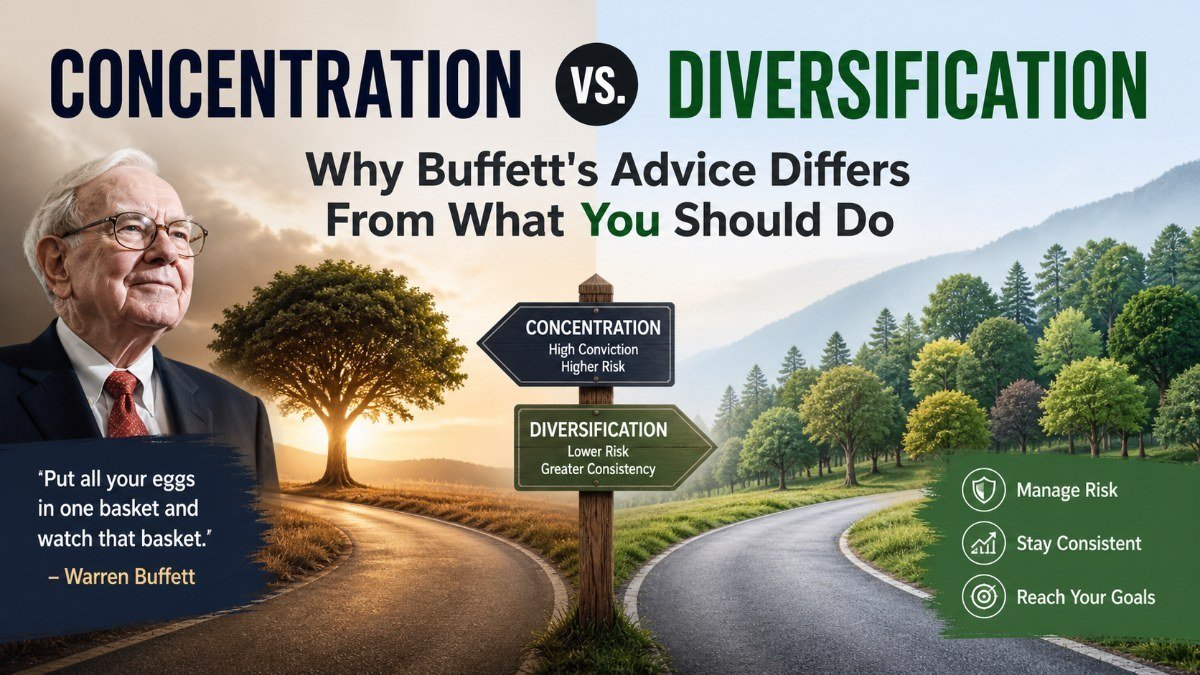
Warren Buffett has said, in various forms over several decades, that diversification is protection against ignorance and makes little sense for those who know what they are doing. He has also said, with equal clarity and consistency, that most people should simply buy a low-cost S&P 500 index fund and hold it for life. These two positions are not contradictory. They are, in fact, the same idea expressed from two different vantage points. Understanding why requires being honest about something most active investors resist confronting: whether they actually have an edge, or whether they only believe they do.
The Logic Behind Concentrated Portfolios
Buffett’s case for concentration rests on a straightforward premise. If you have studied a business deeply, understand its competitive position, can estimate its intrinsic value with reasonable confidence, and are buying it at a meaningful discount to that value, then spreading your capital across dozens of other ideas you know less well actively dilutes your best thinking. Every additional holding beyond your highest-conviction ideas is, by definition, a lower-conviction idea. Why would you want a lower-conviction idea to have a meaningful weight in your portfolio?
This is not a fringe view. Charlie Munger ran a concentrated partnership in his early years, at times holding just a handful of positions. Philip Fisher, whose work heavily influenced Buffett, argued that owning shares in fifteen to twenty companies was the absolute upper limit for any investor who genuinely understood each business. The academic literature on active management broadly supports the idea that a manager’s best ideas, measured by the positions they most overweight relative to a benchmark, tend to outperform. The problem is that most managers hold many more positions than their genuine best ideas, diluting returns down toward mediocrity.
Concentration is not a strategy in itself. It is what rational portfolio construction looks like when genuine, verifiable analytical edge exists. Without that prerequisite, concentration is simply undiversified risk wearing conviction as a costume.
What Edge Actually Means
The word “edge” is used loosely in investing, often as a synonym for confidence. That is a dangerous conflation. A real edge means you possess information or analytical capability that is (a) accurate, (b) not already reflected in the current price, and (c) sufficiently durable to matter over the horizon you plan to hold. All three conditions must be met simultaneously.
Buffett’s edge over a long career has come from several compounding sources: an extraordinary capacity to read financial statements and identify durable competitive advantages; decades of accumulated pattern recognition across hundreds of industries; access to management teams and private deal flow unavailable to most participants; a permanent, low-cost capital base through Berkshire’s insurance float that gives him structural advantages during dislocations; and, critically, the psychological temperament to hold through prolonged periods of underperformance without abandoning a thesis. These are not things you accumulate by reading a few annual reports on a Sunday afternoon.
Most retail investors, if they are honest, have a genuinely deep understanding of perhaps one or two industries where they have spent their professional careers. Even that domain expertise only translates into investment edge if it leads to insights about future business performance that are not already priced in by professional analysts who are also specialists in that field. The bar is high. Research on active fund management consistently shows that the majority of professional fund managers, with full-time research teams, fail to outperform their benchmarks net of fees over long periods. The implication for an individual investor running a concentrated book based on part-time research is sobering, not discouraging in a dismissive sense, but sobering in the sense that demands honest self-appraisal.
The Advice Buffett Gives Retail Investors
Buffett’s recommendation to ordinary investors has been consistent for decades. In his 2013 letter to Berkshire Hathaway shareholders, he described instructions he had left for the trustee of his wife’s estate: put 10% in short-term government bonds and 90% in a very low-cost S&P 500 index fund. He specifically named Vanguard as the vehicle of choice. He added that he believed the trust’s long-term results from this policy would be superior to those achieved by most investors, including pension funds, institutions, and individuals, who employ high-fee managers.
He has repeated this recommendation in interviews, at annual meetings, and in written form many times since. The advice is not conditional on market conditions, not adjusted for interest rate cycles, not qualified by sector valuations. It is a clean, durable, structural recommendation: most people do not have edge, and for those people, the rational response is to buy the market cheaply and let compounding do the work over decades.
This is exactly what the empirical data on passive versus active investing supports. Research from S&P Dow Jones Indices, published annually in their SPIVA reports, shows that over rolling fifteen-year periods, the large majority of actively managed U.S. equity funds underperform the S&P 500 after fees. The numbers vary by year and category, but the direction of the finding is consistent and has been replicated across geographies and asset classes. Index investing is not a consolation prize. For most participants, it is the highest-probability path to long-term wealth accumulation.
The Asymmetry of Being Wrong
There is another dimension to this conversation that receives less attention than it deserves: the difference between being wrong in a diversified portfolio and being wrong in a concentrated one.
In a well-diversified index fund holding hundreds or thousands of companies, the failure of any single business is a rounding error. The investor feels nothing. Enron is in the index; Enron collapses; the index continues compounding. In a ten-stock portfolio where one position is 20% of capital, a permanent impairment of that holding is a devastating event. It does not just hurt the return for a year. It destroys capital that will never compound again. The math of loss recovery is brutal: a 50% loss requires a 100% gain just to break even.
This asymmetry means that the cost of being wrong about your own edge is not symmetrical with the benefit of being right. If you are wrong about having edge and you diversify anyway, you earn approximately the market return. That is a good outcome. If you are wrong about having edge and you concentrate anyway, you risk permanent, large-scale capital destruction. The rational response to uncertainty about one’s own skill level is not to assume the best case.
The investor who diversifies without needing to loses very little. The investor who concentrates without the edge to justify it can lose everything. That asymmetry alone justifies caution for most people.
Where the 200-Week SMA Fits In
For investors who use long-cycle technical signals, including the 200-week simple moving average that this site takes seriously as a risk management tool, there is a useful parallel to draw here. The 200-week SMA is not a stock-picking tool. It does not tell you which companies to concentrate in. What it does is help identify broad market regimes: periods where the weight of evidence suggests the long-term trend is intact versus periods where it may be breaking down in ways that historically precede extended drawdowns.
Using that signal within a diversified, index-based portfolio is coherent and disciplined. Using it to time positions in a concentrated three-stock book is applying a broad macro indicator to idiosyncratic risk, which is a category error. The signal was designed for, and performs best against, broad market instruments. An investor who holds an S&P 500 or MSCI World index fund and uses the 200-week SMA as one input into their allocation decisions is working in the spirit of that tool. A trader who uses it to rotate between five individual stocks is asking the signal to do something it was never built for.
When Concentration Makes Sense for Non-Professionals
This is not an argument that retail investors should never hold individual stocks. There are circumstances where concentration in individual positions is rational even outside a professional investment management context.
First, if an investor has spent twenty or thirty years in a specific industry, understands the competitive dynamics intimately, can read supplier contracts, track channel inventory, and interpret technical changes that analysts at generalist funds routinely miss, that person may genuinely have edge in a narrow domain. Even then, the sensible approach is usually to express that edge in a small satellite portion of an otherwise diversified portfolio, not to bet the entire retirement account on it.
Second, some investors hold concentrated positions in a single company because they work there or founded it. That is a different situation from active stock selection, though it still carries substantial concentration risk that is worth managing deliberately over time through systematic diversification into broader holdings.
Third, there is the question of transaction costs and simplicity. A small portfolio with limited capital may, for purely practical reasons, hold fewer positions. That is fine as a starting point, but as capital grows, diversification becomes more achievable and more valuable.
The consistent thread through all of these cases is that concentration should follow from something real, a genuine and honest advantage, not from the desire to make investing feel more interesting or to avoid the perceived mediocrity of an index return. Index returns are not mediocre. Over long time horizons and relative to the results of most active participants, they are excellent.
Applying This Framework to Your Own Portfolio
The practical question for most investors reading this is not philosophical. It is: where should my money actually be? The honest framework for answering that question has three steps.
First, identify any domain where you have a verifiable information or analytical advantage, not just interest or enthusiasm, but a genuine structural edge that a full-time professional analyst covering the same sector would not easily replicate. Be rigorous. Most investors, if they are honest, will find this list is either empty or very short.
Second, if such an edge exists, consider a core-satellite structure. The core, representing the substantial majority of your investable assets, goes into low-cost, broadly diversified index funds tracking something like the S&P 500 or the MSCI World Index. The satellite, representing a smaller allocation you can afford to lose without threatening your long-term financial security, is where you express your highest-conviction, edge-backed ideas in individual positions.
Third, revisit that edge assessment periodically and honestly. Markets evolve, competitive landscapes shift, and informational advantages erode. An edge that was real five years ago may no longer exist. The investors who get into the deepest trouble are those who mistake past returns for current edge, building a narrative around prior wins that justifies continued concentration long after the structural advantage that produced those wins has disappeared.
Buffett’s greatness as an investor is inseparable from his capacity for honest self-assessment. His advice to retail investors reflects the same intellectual honesty applied outward: he knows most people do not have what he has, and he tells them so plainly.
Frequently Asked Questions
Q: If Buffett concentrates his own portfolio, why shouldn’t I do the same?
A: Because Buffett’s concentration is backed by decades of specialized expertise, a permanent and low-cost capital structure, and access to information and deal flow that most investors simply do not have. Copying the output of a process without possessing the inputs that make it work is not a sound strategy. Buffett himself has said this directly and repeatedly by recommending index funds to retail investors.
Q: How many stocks do you need to be considered adequately diversified?
A: Research historically suggests that much of the idiosyncratic, company-specific risk in a portfolio is reduced once you hold somewhere between 20 and 30 uncorrelated stocks. However, sector and geographic concentration matter too. A portfolio of 25 technology companies is not well diversified. The most straightforward path to genuine diversification remains a broad, low-cost index fund that spans hundreds or thousands of securities across sectors and regions.
Q: Can I use the 200-week SMA as a tool within a concentrated stock portfolio?
A: The 200-week SMA is a broad market signal that performs best when applied to broad market instruments like major index ETFs. Applying it to individual stock positions mixes a macro trend indicator with company-specific risk, which are different categories of analysis. It is more coherent to use it to manage your overall market exposure within an index-based portfolio than to time entries and exits in a handful of individual names.
Q: Is there a middle ground between full indexing and Buffett-style concentration?
A: Yes, and it is what most thoughtful practitioners recommend. A core-satellite structure allocates the large majority of capital to low-cost broad index funds, providing reliable market participation and genuine diversification, while a smaller satellite allocation allows for individual stock ideas where genuine edge exists. This approach preserves the long-term compounding benefits of indexing while giving investors with real domain knowledge a structured way to express it without betting their entire financial future on it.