№ 017 · Strategy · · 12 min
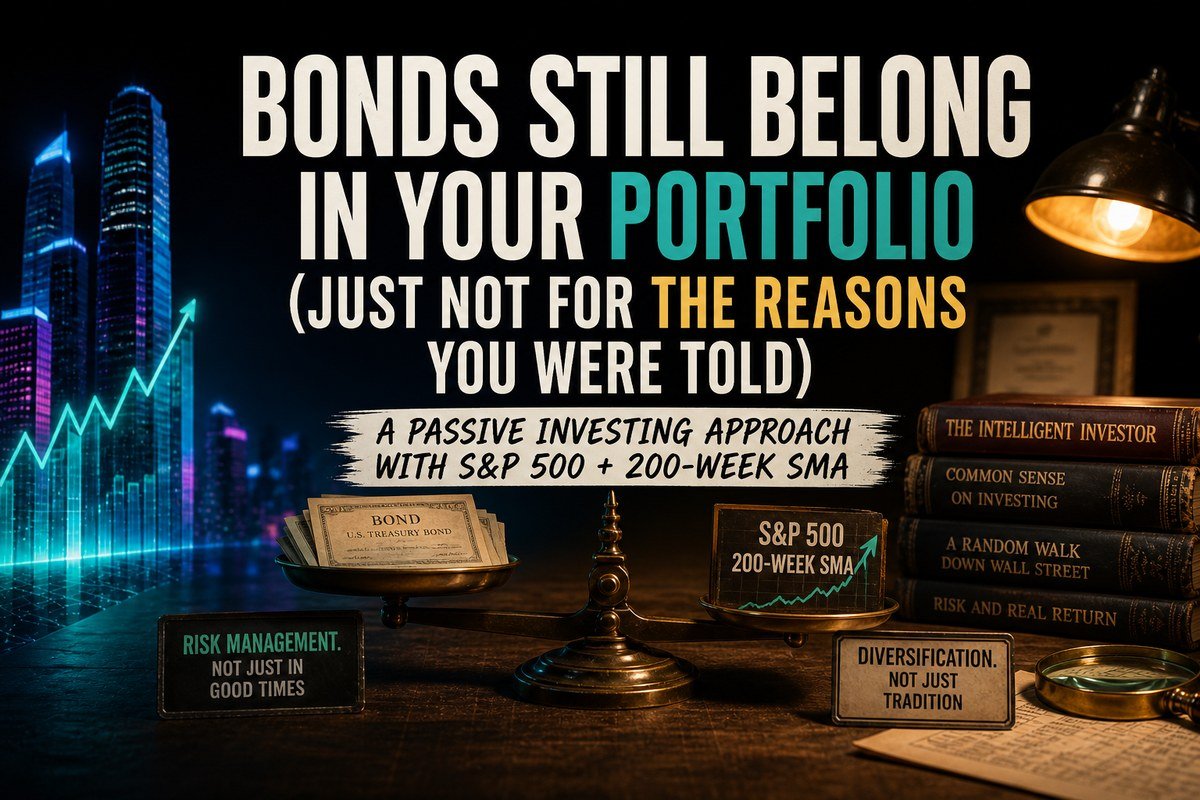
Bonds Still Belong in Your Portfolio (Just Not for the Reasons You Were Told)
The 2022 bond collapse was a volatility event, not a structural verdict. Understanding the three distinct jobs bonds perform reveals why abandoning fixed income entirely is one of the costliest mistakes a long-term investor can make.

In 2022, almost every serious investor heard some version of the same argument: bonds fell alongside stocks, so what exactly is the point of them? The 60/40 portfolio, a construction that had served institutional and retail investors for decades, posted one of its worst years on record. Aggregate bond indices lost roughly 13 percent. Long-duration Treasuries lost considerably more. Investors who had been told bonds were the “safe” part of their portfolio watched their fixed income allocation bleed out in real time, and understandably, many drew a permanent conclusion from a temporary event.
That conclusion was wrong. Not slightly wrong, substantially wrong. And the cost of acting on it will reveal itself clearly when the next serious equity bear market arrives.
Why 2022 Was the Exception, Not the Rule
To understand 2022, you need to understand what made it historically unusual. The Federal Reserve raised the federal funds rate by more than 400 basis points in roughly twelve months, one of the fastest tightening cycles in modern history. This happened because inflation, which had been functionally absent for a decade, arrived simultaneously with a supply shock from pandemic disruptions and an energy price spike following the conflict in Ukraine. The result was a regime where the Fed was forced to crush demand precisely when equity markets were already repricing growth expectations lower.
In that specific environment, stocks and bonds fell together. Stocks fell because earnings expectations were being revised down and discount rates were rising. Bonds fell because rising rates reduce the present value of fixed future cash flows. Both assets were hit by the same variable at the same time: the repricing of the risk-free rate.
Research spanning 70-plus years of market data shows this is deeply unusual. In the 2000 to 2002 dot-com collapse, the aggregate bond index posted positive returns in every calendar year while equities fell by nearly half. In 2008 and 2009, long-duration Treasuries produced double-digit gains while the S&P 500 lost more than 50 percent from peak to trough. In the COVID crash of March 2020, bonds again served as a meaningful buffer. The negative correlation between stocks and high-quality bonds held consistently across multiple crises spanning three decades. One extraordinary year broke that pattern. That is not a structural indictment, it is a data point in a long series.
If 2022 taught you never to own bonds, you learned the wrong lesson. You learned what happens during a rapid inflation shock. You did not learn what bonds do during recessions, credit crunches, or deflationary panics, which is where their value has historically been clearest.
The Three Jobs Bonds Actually Do
One reason investors misread 2022 is that they conflated three separate functions bonds perform, treating them as if bonds had one job and had failed at it. The three jobs are distinct, and they rotate in importance depending on your life stage and the interest rate environment.
The first job is income generation. A bond pays a coupon. At current yields of 4 to 5 percent on investment-grade Treasuries and 4.5 percent or higher on guaranteed instruments like CDs and GICs, that income is genuinely competitive with dividend yields from broad equity indices for the first time since before the 2008 financial crisis. This shifts the calculus materially for income-focused investors who had been forced to reach into equities purely because bonds were yielding 1 to 2 percent.
The second job is portfolio ballast: providing a shock absorber when equities collapse. This is the function 2022 temporarily disrupted, and it is the one most investors focus on exclusively. But as the historical record shows, ballast works most of the time and failed in 2022 for a specific, unusual reason. For a retiree drawing down a portfolio, even one year of ballast failure is painful. Across a retirement spanning twenty to thirty years, the asset class performing its ballast role in multiple other crises more than compensates.
The third job, and the one that receives almost no attention in mainstream financial coverage, is rebalancing fuel. When equities crash 30 or 40 percent, the investor who holds bonds has something to sell at relatively stable prices in order to buy equities at dramatically reduced valuations. This is the mechanism by which diversified portfolios systematically buy low without requiring investor willpower or market timing. It is a structural, automatic advantage that an all-equity portfolio cannot replicate.
Duration Matching: The Real Skill That Beats “Bonds Are Dead”
A substantial part of 2022’s damage was self-inflicted by investors who held the wrong bonds for the environment without understanding why. Long-duration bond funds carrying average maturities of 10 to 20 years are exquisitely sensitive to interest rate changes. When rates rise by 4 percentage points rapidly, a 15-year average duration fund loses roughly 50 to 60 percent of that rate rise in price terms. That is enormous volatility for an asset class sold as conservative.
Short-duration bonds, by contrast, mature quickly, return principal, and allow reinvestment at higher rates. An investor holding a two-year Treasury in 2022 experienced modest mark-to-market losses and within months was reinvesting at substantially higher yields. TIPS (Treasury Inflation-Protected Securities) offered a third option: a direct hedge against the inflation that was the root cause of 2022’s pain.
The lesson is not “abandon bonds.” The lesson is “hold bonds appropriate to your time horizon and rate environment.” Duration matching, the practice of aligning the maturity profile of your bond holdings with your actual investment horizon and liability structure, is what separates disciplined fixed income investing from passive ownership of a blunt instrument. Research and practitioner experience consistently point to this as a skill worth developing, or delegating to a low-cost index approach that at least makes duration explicit.
Why 60/40 Failed and How to Think About Fixing It
The 60/40 portfolio did not fail because bonds are structurally broken. It failed partly because many investors were not actually running 60/40. Bull markets in equities throughout the 2010s caused portfolio drift. A portfolio that started at 60 percent equities in 2012 and was never rebalanced likely sat at 70 to 75 percent equities by 2021. When markets fell in 2022, the actual equity exposure was far higher than the label suggested.
There is also the critical distinction between owning bond funds and owning bonds directly. As one thoughtful reader of a prominent investing blog articulated clearly: if you own a Treasury that matures in ten years and yields 4 percent, you will earn 4 percent annually and receive your principal back at maturity regardless of what rates do in the interim. The mark-to-market loss is irrelevant if you do not sell. Bond fund investors, by contrast, own a structure that must sell holdings when other investors redeem. If redemptions occur during a rate spike, the fund must realize losses that a direct bond holder could simply wait out.
This distinction matters enormously for the psychology of ownership. Investors who watched their bond fund drop 13 percent in 2022 felt the full pain in their brokerage statement. An investor holding a ladder of individual Treasuries saw coupon payments arrive on schedule while knowing their principal would return intact at maturity. The economic outcome across a full rate cycle is often similar, but the behavioral experience is entirely different.
The Rebalancing Engine Your Paycheck Cannot Replace
One of the most intellectually honest positions in personal finance comes from a simple observation: if you are actively employed, contributing regularly to your investment portfolio, and have fifteen or more years before you need to draw on it, your paycheck is already doing part of what bonds do. Regular contributions into a falling market buy more units at lower prices. Your earned income smooths returns. In that specific life situation, holding little or no bonds is a defensible choice, because the human capital you are converting into financial capital serves as a stabilizing force.
That logic collapses the moment you stop earning. A retiree drawing down a portfolio has no paycheck buffer. If equities fall 40 percent in their first two years of retirement and they own only equities, they are forced to sell depressed assets to fund living expenses. This is sequence-of-returns risk in its most destructive form, and research on safe withdrawal rates consistently identifies the early retirement period as where permanent capital damage most often occurs. Bonds, in this context, are not about yield-chasing. They are about having something that holds its value so you are not forced to liquidate equities at the worst possible moment.
For a retiree, bonds are not about generating returns that compete with stocks. They are about preserving the option to let stocks recover before you have to sell them.
The mechanics here are straightforward. A retiree holding 30 to 40 percent in bonds and cash equivalents has two to four years of living expenses in assets that are unlikely to fall sharply during an equity crash. That buffer means they can draw from bonds while equities recover, avoiding the permanent impairment that forced selling at depressed prices creates. Research on safe withdrawal rates consistently supports the view that a moderate bond allocation in the early retirement years materially improves outcomes, even if bonds underperform equities over the full retirement period.
GICs, Treasuries, and Short-Duration Bond ETFs: When Each Wins
The practical question for most investors is not whether to hold bonds but which form makes sense. Three options dominate the conversation for individual investors: guaranteed instruments (GICs or CDs), direct Treasury ownership, and broad-market bond ETFs.
Guaranteed instruments like GICs and CDs offer simplicity and zero mark-to-market volatility. You lock in a rate, and it does not move on your statement. In the current environment, one-year GICs are yielding roughly 4.5 percent or higher, which exceeds the yield to maturity on broad-market bond ETFs. The catch is illiquidity. Investors who lock money in a five-year GIC and then need it for an unplanned expense face real costs to access it. History also shows that when rates fall sharply, broad bond ETFs surge. In 2019, broad-market bond ETFs returned roughly 6.8 percent. In 2020, they returned approximately 8.5 percent. Investors sitting in GIC ladders during those years earned well under 2 percent. The premium that GICs offer in a rising-rate environment disappears quickly when rates reverse.
Direct Treasury ownership sits between these options. It offers the certainty of GICs (you know your return if you hold to maturity) combined with the liquidity of a traded security. A three-year Treasury yielding 4.2 percent can be sold in a liquid market if circumstances change, whereas a GIC often cannot. For investors who want certainty without sacrificing flexibility entirely, laddering individual Treasuries across two, three, and five-year maturities is a practical and underrated approach.
Broad-market bond ETFs make the most sense for investors who want simplicity, automatic reinvestment, and exposure to potential capital gains if rates fall. They are appropriate for tax-advantaged accounts where the volatility of the fund’s net asset value is visible but not emotionally disruptive. The key is understanding that bond ETF volatility is real, even if it tends to reverse over time, and sizing the allocation accordingly.
The case for holding both bond ETFs and guaranteed instruments simultaneously is stronger than most investors realize. They are not competing products. They hedge each other: ETFs provide liquidity and capital appreciation potential when rates fall, while guaranteed instruments provide certainty and superior current yield when rates are elevated. Layering both into a fixed income allocation is simply another application of diversification logic.
The Yield Environment Has Changed Everything
Perhaps the most important shift in the bond landscape that many investors have not fully absorbed is the yield reset itself. For the decade between roughly 2010 and 2021, the argument against bonds was partially valid on income grounds: why hold an asset yielding 1.5 to 2 percent when equities offered dividend yields of 1.8 to 2.5 percent plus growth? The income tradeoff was genuinely unfavorable.
At 4 to 5 percent yields, bonds are no longer a sacrifice. They are a choice. That changes the entire framework for how fixed income fits into a long-term portfolio.
That tradeoff has reversed. A five-year Treasury yielding 4.3 percent today competes directly with the dividend yield of the S&P 500 with no earnings risk, no valuation risk, and no currency risk for USD-based investors. TIPS at positive real yields of 1.5 to 2 percent offer inflation protection that was literally unavailable (at any reasonable price) during the near-zero rate era. Short-duration investment-grade corporate bonds at 5 percent are generating income that equity investors had to reach into high-yield or emerging markets to find just three years ago.
The investors who abandoned bonds entirely in 2022 locked in their losses and missed both the income stream that followed and the potential for capital appreciation if and when rates eventually decline from current levels. That is not a small cost. It is a permanent destruction of the compounding that those instruments would have produced.
Frequently Asked Questions
Q: If bonds and stocks both fell in 2022, why should I expect bonds to protect me next time?
A: Because 2022 was driven by a rapid inflation shock that pushed the risk-free rate sharply higher, a scenario that hurts both asset classes simultaneously. In recessions driven by credit stress, demand collapse, or financial panic (2000, 2008, 2020), bonds have historically provided substantial positive returns while equities fell. Those scenarios are statistically more common than the 2022 inflation shock.
Q: Should I own bond funds or individual bonds?
A: It depends on what you need. Individual bonds held to maturity eliminate mark-to-market volatility and provide a guaranteed return regardless of what rates do. Bond funds offer liquidity, diversification, and potential capital gains if rates fall, but they expose you to the realized losses of other investors who sell during panics. Both have a place, understanding the difference matters more than picking one categorically.
Q: If I am young and still working, do I really need bonds?
A: Probably not much, if any. Regular income from employment already smooths the return sequence that bonds are designed to provide. The case for bonds strengthens as you approach and enter retirement, when sequence-of-returns risk becomes the primary threat to a portfolio’s longevity.
Q: Is the 60/40 portfolio worth following as a fixed rule?
A: No fixed rule survives contact with every market environment unchanged. The 60/40 framework is a useful starting point, not a permanent prescription. The more important principle is that bond allocation should reflect your time horizon, drawdown risk, income needs, and emotional capacity to hold through equity volatility, all of which change over a lifetime.