№ 018 · Strategy · · 13 min
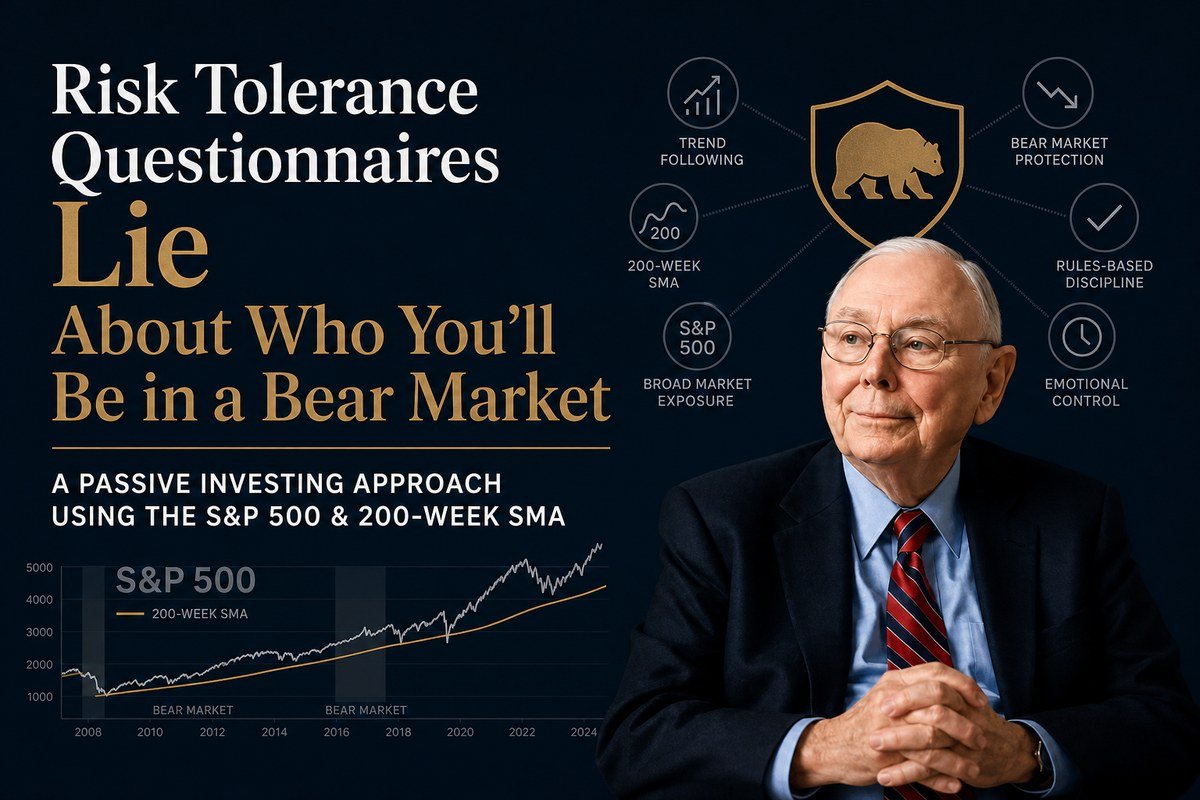
Risk Tolerance Questionnaires Lie About Who You’ll Be in a Bear Market
Most risk tolerance questionnaires measure how you feel about losses in theory, not how you behave when your portfolio is actually down 30%. There is a significant gap between the two, and building a portfolio around the hypothetical version of yourself is one of the most expensive mistakes a long-term investor can make.

Somewhere in the onboarding flow of almost every brokerage, robo-adviser, and financial planning platform sits a questionnaire. It asks you how you would feel if your portfolio dropped 20 percent. It asks whether you would buy more, hold steady, or sell. It presents hypothetical scenarios involving timelines and loss magnitudes and invites you to rate your comfort on a numbered scale. At the end, it assigns you a risk profile: conservative, moderate, aggressive, or some variation thereof.
The problem is not that these questionnaires are poorly designed. Many of them are thoughtfully constructed and grounded in genuine academic frameworks. The problem is more fundamental: they are measuring the wrong thing. They measure how you think you will respond to a loss. What actually determines your long-term wealth is how you respond when the loss is real, sustained, and accompanied by credible-sounding arguments that it is going to get worse.
Those are very different psychological events, and the gap between them is where a great deal of long-term wealth gets destroyed.
The Hypothetical Self vs. the Actual Self
When you complete a risk tolerance questionnaire, you are almost certainly doing so during a period of relative market calm, or at least from the psychological distance of a screen and a quiet room. Your portfolio exists as a number, not a lived experience. The question “how would you feel if this number dropped by 25 percent?” is processed by the cognitive, deliberative part of your brain. You apply logic. You remind yourself that markets recover. You answer that you would hold, or even buy more.
This is not dishonesty. It is a well-documented feature of human cognition. Behavioral economists refer to an empathy gap between the “cold” emotional state in which decisions are made and the “hot” emotional state in which they are actually experienced. When you imagine being down 25 percent, you are not actually experiencing a 25 percent loss. You are imagining one, which activates a much gentler version of the same neural response.
The real version arrives differently. It builds slowly, then accelerates. Your portfolio is down 8 percent, which feels manageable. Then it is down 15 percent over three weeks while every financial media outlet explains in authoritative detail why this time genuinely is different. Then it is down 27 percent, and a colleague tells you they moved everything to cash last month. The deliberative, logical part of your brain is still there. But it is now competing with a fear response that operates faster, louder, and with stronger evolutionary wiring.
One’s true risk tolerance can be hard to gauge until having experienced a real declining market with money invested. The questionnaire captures the deliberative self. The bear market introduces the emotional self. For most investors, these are not the same person.
Prospect theory, developed by Daniel Kahneman and Amos Tversky, provides the underlying framework here. Empirical research consistently finds that losses are experienced with roughly twice the psychological intensity of equivalent gains. A $10,000 loss does not feel like the mirror image of a $10,000 gain. It feels like considerably more. That asymmetry is not irrational in some simple sense. It may even have evolutionary roots. But it means that no questionnaire answered during a calm period can accurately calibrate how a real loss of that magnitude will actually feel when it is happening in real time, to real money, with an uncertain endpoint.
Why the Questionnaire Format Compounds the Problem
Standard risk tolerance questionnaires have a structural bias that makes underestimation of loss aversion even more likely. They are almost always completed at the beginning of an investor relationship, when the investor is motivated, optimistic, and often doing so in a rising market environment. The recency bias in human cognition means that recent market experience heavily weights forward-looking expectations and emotional forecasts. Someone onboarding in the fourteenth month of a strong bull market will systematically report higher risk tolerance than the same person onboarding in the third month of a bear market, even though their actual financial circumstances and investment horizon are identical.
There is also a social desirability dimension. Being classified as “conservative” can feel financially embarrassing, as if it implies a lack of sophistication or long-term discipline. Many investors unconsciously shade their answers toward the more aggressive end of the range, not because they have thought carefully about their actual behaviour under stress, but because the aggressive framing sounds like the wiser, more financially educated choice.
The result is that portfolios are frequently constructed around an inflated version of the investor’s actual risk capacity. The portfolio looks correctly calibrated on paper. The allocation matches the stated profile. But it does not match the person who will be watching that portfolio decline at an accelerating rate in a real bear market, listening to deteriorating economic data, and feeling the psychological weight of every percentage point.
What the Behaviour Gap Actually Costs
The consequences of this mismatch are not theoretical. Tracking of actual returns earned by fund investors versus the published returns of the funds themselves consistently shows a substantial gap between the two. The average investor in an equity fund has historically earned meaningfully less than the fund’s own reported return, with estimates of the behaviour gap running at roughly 2 to 4 percentage points per year over long measurement periods. That gap is not caused by fees or fund selection. It is caused almost entirely by timing decisions: investors buying after strong performance and selling after poor performance, which is the behavioral signature of someone whose stated risk tolerance did not match their actual pain threshold.
Compound that gap over 20 years and the wealth destruction becomes concrete. A portfolio compounding at 8 percent annually grows to roughly 4.7 times its starting value over two decades. A portfolio where the investor earns closer to 5 percent annually due to behavioral drag grows to roughly 2.7 times. The difference is not a rounding error. It is the single largest source of underperformance for most retail investors, dwarfing fund fees, tax inefficiency, and asset allocation decisions by a wide margin.
The behaviour gap between what an index fund earns and what its average investor earns is driven almost entirely by self-inflicted timing decisions made under emotional duress. This is the real cost of a portfolio miscalibrated to a hypothetical risk tolerance rather than a lived one.
A More Reliable Test: What Have You Actually Done?
If hypothetical questionnaires are poor predictors of bear-market behaviour, a more honest framework looks backward rather than forward. Lived experience during real drawdowns is a far stronger signal of actual risk tolerance than any scenario-based survey.
The first and most important question is: what is the maximum drawdown you have actually held through without selling? Not what you believe you could hold through. Not what you held through in a portfolio you were not watching closely. What real drawdown, in a portfolio you followed actively, did you stay invested through, without reducing equity exposure, from peak to trough?
For investors who were in equities during 2008 and 2009, when the S&P 500 lost roughly half its value over approximately 17 months, that experience is extraordinarily informative. Investors who held through that period and continued contributing have demonstrated a genuine high risk tolerance, not a hypothetical one. Investors who reduced equity exposure at any point during that decline have demonstrated something closer to moderate or conservative actual risk tolerance, regardless of how they scored on any questionnaire.
The COVID crash of early 2020 provides a shorter but sharper test. The S&P 500 fell sharply in a matter of weeks, faster than almost any prior decline in modern market history. Some investors who had held through 2008 without flinching found the speed of this decline more unsettling than its depth. Their reaction was informative. Others continued automated contributions throughout and gave the experience little conscious attention. Their behaviour revealed a genuine capacity for equity exposure that no questionnaire could have reliably confirmed in advance.
The second diagnostic question is closely related: did you continue making automatic contributions throughout past bear markets, without pausing or redirecting them? Maintaining contributions through a decline is a stronger behavioral signal than simply not selling, because it requires an active decision in the correct direction under exactly the conditions where most investors’ instincts point the other way. An investor who kept contributing through the 2001 to 2003 bear market, and again through 2007 to 2009, has demonstrated a behavioural pattern that no questionnaire administered in calmer times could reliably predict.
Recency Bias and the Bull Market Inflation Effect
There is a particular timing problem that affects questionnaire reliability in ways that are rarely discussed. Risk tolerance scores tend to drift upward during extended bull markets, not because investors genuinely become more capable of handling losses, but because the memory of what a real bear market feels like fades. After several years of strong equity returns, the abstract knowledge that markets can fall 40 percent competes poorly with the visceral experience of watching a portfolio grow steadily. The danger feels academic.
This creates a systematic pattern: investors take on more equity risk during the late stages of bull markets, precisely when valuations are stretched and the probability of a significant correction is elevated, and then discover during the subsequent decline that their actual pain tolerance was considerably lower than their questionnaire suggested. The portfolio is positioned for the investor they were during the questionnaire. The market is testing the investor they actually are.
Overconfidence bias compounds this effect. Research consistently shows that investors overestimate their ability to manage emotional responses to adverse outcomes. This is not unique to unsophisticated investors. Experienced, financially literate investors exhibit the same bias, sometimes more acutely, because confidence in their own analytical frameworks gives them additional reason to believe they will behave rationally under stress. The evidence on actual behaviour during market drawdowns suggests that confidence in one’s rationality is not a reliable substitute for demonstrated behaviour under real conditions.
Building the Portfolio Around the Real You
The practical implication of all this is straightforward, if uncomfortable: your portfolio should be calibrated to the investor you have demonstrated you are, not the investor you believe yourself to be.
If the maximum real drawdown you have held through without selling is 20 percent, then an all-equity portfolio is almost certainly miscalibrated for you, regardless of what your questionnaire says. The next bear market that takes equities down 40 percent will not be the one where your behaviour finally matches your stated tolerance. It will be the one where the mismatch between portfolio construction and actual temperament becomes expensive.
A more honest portfolio construction process starts with that backward-looking question about maximum held drawdown, incorporates the contribution behaviour record, and then adds a deliberate margin of safety. If you held through a 20 percent drawdown without selling, construct a portfolio whose expected maximum drawdown in a severe bear market sits at or below that threshold, not right at its edge. Bear markets have a way of being longer and more psychologically grinding than their historical averages suggest they will feel in the moment. The 2000 to 2002 bear, for instance, produced a real cumulative loss of more than 34 percent for an 80/20 equity-bond portfolio, and lasted long enough to exhaust the resolve of many investors who had initially held firm.
Automatic contributions deserve special attention as a structural tool rather than just a behavioral nicety. An investor who has set up a fixed monthly contribution to a broad index fund and committed to not adjusting it regardless of market conditions has done something questionnaires cannot: they have pre-committed the emotionally reactive version of themselves. The decision is made in advance, in a calm state, and the system executes it regardless of how the market environment feels in the moment. This is not just behavioral hygiene. It is a genuine structural edge. The behaviour gap described earlier is not a significant problem for investors running automated contribution programmes in low-cost index funds and genuinely not monitoring them closely during downturns. It primarily affects investors who are actively engaged with their portfolios during periods of stress and who face repeated decision points at exactly the moments when human emotional architecture is most likely to produce the wrong answer.
An investor who automated contributions through two bear markets and never paused them has told you more about their actual risk tolerance than any questionnaire can. Past behaviour under real conditions is the only reliable data point you have.
What a Better Assessment Looks Like
A more useful risk assessment process does not abandon questionnaires entirely, but uses them differently. Rather than asking hypothetical questions about imagined future losses, a better process asks empirical questions about past behaviour. Have you ever sold an equity position during a market decline? If so, how large was the decline at the time? Have you ever paused regular contributions during a period of market stress? Have you ever moved to cash or increased bond allocation during a bear market? These questions are less comfortable to answer honestly, but they are far more predictive of future behaviour.
For investors without a meaningful investment history, a practical alternative is to start with a deliberately conservative portfolio and observe actual behaviour through the first significant correction. The goal is not to identify the maximum equity allocation someone can theoretically tolerate, but the maximum allocation they will demonstrably hold through a real decline without making the behavioural error that permanently damages their long-run result. It is better to own 60 percent equities and hold that allocation through a bear market than to own 90 percent equities and sell a portion of it into a declining market. The former is a suboptimal portfolio held correctly. The latter is a theoretically aggressive portfolio held incorrectly, and the real-world outcome of the second is often worse than the first.
The goal of risk profiling, in the end, is not to produce a document that justifies a particular asset allocation. It is to produce a portfolio that the actual, emotional, under-stress version of a given investor will continue to hold through a bear market, continue contributing to during it, and then benefit from the recovery that follows. Questionnaires can contribute to that process. They cannot substitute for honest reflection on what you have actually done when the market has fallen and kept falling and every day brought new reasons to think it might keep going.
Frequently Asked Questions
Q: If risk tolerance questionnaires are unreliable, should I ignore mine entirely?
A: Not entirely. A well-designed questionnaire can surface useful information about your investment timeline, income stability, and general financial goals. One significant limitation is its ability to predict emotional behaviour under real bear market conditions. Use it as a starting point, then calibrate it against your actual behaviour in past market declines before finalising your asset allocation.
Q: How should a first-time investor who has never experienced a real bear market assess their actual risk tolerance?
A: Start with a more conservative allocation than your questionnaire suggests, observe your genuine emotional response during the first significant correction, and adjust from there. A 60/40 portfolio that you hold without anxiety through a 15 percent drawdown tells you more than any questionnaire, and gives you the option to increase equity exposure as you develop a real behavioural track record.
Q: Does automating contributions really help enough to matter?
A: It matters significantly. The behaviour gap between fund returns and investor returns is driven almost entirely by poorly timed entries and exits made under emotional duress. An automated contribution programme that runs regardless of market conditions removes the decision point entirely during the periods when human emotional architecture is most likely to produce the wrong decision. Combined with infrequent portfolio checking during downturns, it is one of the most effective structural tools available to a long-term investor.
Q: Is a higher risk tolerance always better for long-term investors?
A: No. A risk tolerance that results in selling during a bear market is worse than a lower but accurate risk tolerance that produces no behavioural errors. The optimal allocation is not the most aggressive one you can theoretically justify, but the most growth-oriented one you will demonstrably hold without making errors under real market stress. Getting the calibration right is more important than maximising equity exposure on paper.