№ 022 · Education · · 11 min
The Real Cost of a 1% Fee Over 30 Years (It’s Worse Than You Think)
A 1% annual fee sounds trivial, but compounded over 30 years it can cost you nearly a quarter of your final wealth. Here is the math, and what to do about it.

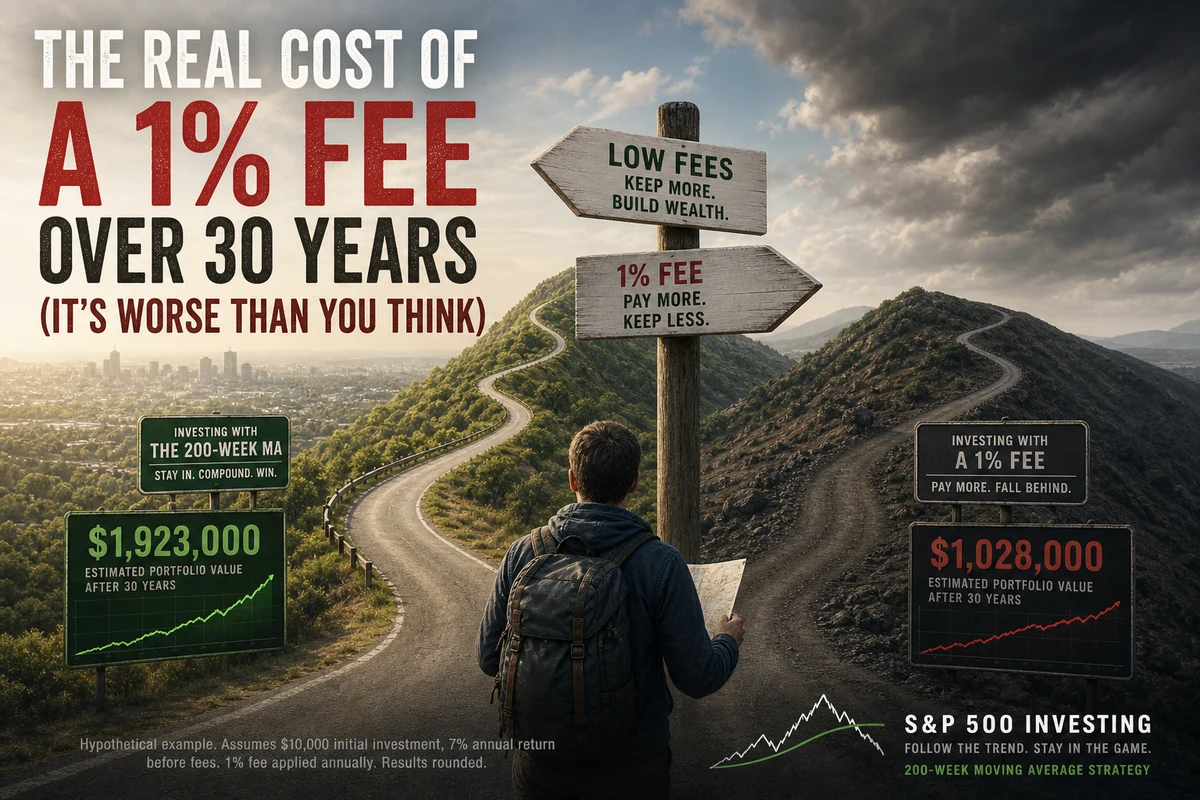
A 1% annual fee sounds almost politely small. It is, after all, just one cent on every dollar, assessed quietly each year without a line item on your brokerage statement. Most investors absorb it as the routine cost of professional management and move on. They should not. Over a 30-year investing career, that single percentage point can consume roughly a quarter of your ending wealth, not through any single bad decision, but through the relentless mathematics of compounding working against you rather than for you.
Why One Percent Feels Small but Isn’t
The psychological trap is straightforward. A 1% fee on a $100,000 portfolio is $1,000 in year one. On its own, that feels manageable. What investors rarely visualise is that the fee is not taken from a static pool. It is taken from the base that compounds every year going forward. Every dollar removed in fees today is a dollar that never compounds into two, then four, then eight dollars over the decades ahead.
Think of it this way: the S&P 500 has delivered a nominal annualised return of roughly 10% and a real (inflation-adjusted) return of approximately 7% over the long run. If you invest $100,000 at a net 7% annual return and leave it untouched for 30 years, you end up with approximately $761,000. Now subtract a 1% annual fee, reducing your net return to 6%, and the same investment grows to roughly $574,000. The fee has not cost you $1,000 a year. It has cost you approximately $187,000 in total ending wealth, an amount that dwarfs the original investment when viewed as foregone compounding.
A 1% fee does not reduce your return by 1%. It reduces your compounding base by 1% every single year, and the damage compounds just as your gains do. Over 30 years, the cost is not additive. It is multiplicative.
The reason this is worse than intuition suggests is that the fee arrives in the early years, when the portfolio is smaller, but its absence in the final years, when the portfolio is large, would have generated the most growth. By removing capital from the compounding engine at every stage, a 1% fee costs you disproportionately in the decade where compounding works hardest: the last ten years.
How Much of Your Return Are You Actually Giving Away?
Frame the problem differently and it becomes even starker. If your portfolio earns 7% annually and you pay a 1% fee, you are handing away roughly one-seventh of your gross return every single year, before inflation, before taxes. In that context, “just 1%” is not a description of the cost. It is a misdirection. You are surrendering about 14% of your annual earnings to a fee. A salaried employee offered that deal would refuse immediately. Long-term investors accept it by default, often without realising the terms.
The financial advice industry has long understood that annual percentage fees are easier to accept psychologically than equivalent lump-sum charges. A $10,000 invoice from a financial planner at the start of the year would prompt scrutiny. A 1% AUM fee drawn quietly from a $1 million portfolio achieves the same extraction with far less resistance. The structure of the fee conceals its true magnitude.
For context on what the market actually charges for passively managed exposure to the S&P 500: Vanguard’s VOO carries an expense ratio of approximately 0.03%, confirmed across multiple cost analyses of index ETF structures. iShares’ IVV runs at a similarly negligible level. Both provide essentially identical market exposure to the same 500 companies. Broad S&P 500 index ETFs generally sit well under 0.10% in annual costs. The difference between under 0.10% and 1.00% is more than 90 basis points, nearly the entire fee. Over 30 years, that spread compounds into a meaningful fraction of your retirement wealth.
The Hidden Layers: Active Funds and Advisory Fees
For many investors, the 1% scenario is not hypothetical, it understates reality. A typical actively managed mutual fund carries an expense ratio that can range from around 0.44% to well above 1%, depending on the strategy and asset class. Layer an advisory fee on top of that, and total annual costs can approach 2% or higher. Some wealth management relationships, particularly those involving proprietary funds and bundled services, carry all-in costs of 2% to 2.5% annually, according to cost analyses of the UK advisory market.
At 2% annual fees against a 7% gross return, your effective net return falls to 5%. Over 30 years, $100,000 grows to approximately $432,000 at 5%, compared to $761,000 at 7%. The fee structure has cost you around $329,000 on a $100,000 starting investment, more than three times the original capital in lost wealth. At that level, the fee manager has not just taken a share of your returns. They have transferred the majority of your compounding power to themselves.
The evidence on whether those fees buy superior returns is not flattering to active management. The SPIVA Scorecard, which S&P Dow Jones Indices has updated continuously since 2002, consistently shows that the majority of actively managed equity funds underperform their benchmark index over 10- and 15-year periods, net of fees. As one analysis of the SPIVA data concluded: “any advantages of active funds are wiped out by the fees.” Even in cases where a manager demonstrates genuine skill at the gross return level, fees tend to absorb the outperformance, leaving ordinary investors with benchmark-minus-costs. For most investors, over most long time horizons, paying for active management has been a poor trade.
Fee Drag Plus Tax Drag: The Full Picture
Fee drag does not operate in isolation. In a taxable account, it is compounded by a second silent cost: the tax drag generated by active trading inside a fund. When a portfolio manager sells a position at a gain, that gain is distributed to shareholders and taxed in the year of distribution. Index funds, by design, trade very little. They buy and hold the index constituents, selling only when the index changes. Active funds trade far more frequently, generating realised gains along the way. Even in years when you have not sold a single unit of the fund yourself, you may receive a taxable capital gain distribution because the manager turned over the portfolio.
For investors in higher income brackets holding funds in taxable accounts, this tax friction can add another 0.5% to 1% of annual drag on top of the stated expense ratio. The combination of a meaningful expense ratio, an advisory fee, and tax drag from active turnover can produce a total annual cost well above 2%, applied against a gross return that the market may deliver at roughly 7% to 10% before any costs. The investor absorbs all the volatility and all the market risk while the fee structure captures a large portion of the upside.
Low-cost index ETFs help on both dimensions. Their expense ratios sit near zero, and their in-kind creation and redemption mechanism means they rarely distribute taxable capital gains internally. As explored in our piece on index funds versus ETFs, the structural tax efficiency of the ETF wrapper can further widen the gap between a low-cost passive investor and a high-cost active one in a taxable account.
Visualising the Damage Across a Typical Career
Consider a 35-year-old investor making regular monthly contributions to a portfolio over a 30-year career. Assuming a 7% gross annual return with near-zero cost index exposure, the portfolio grows to a substantially larger sum than the same contributions compounding at 6% net, after a 1% fee. The further that net return falls, toward 5% under a 2% total fee burden, the larger the shortfall becomes. In each scenario, the investor contributed exactly the same amount of money over exactly the same period. The only variable is what the fee structure allowed to remain in the compounding engine.
What makes this concrete is the shape of the damage. In the early years of a 30-year accumulation, the difference in account balances between a high-fee and low-fee portfolio is relatively small in dollar terms. By year ten, it is noticeable. By year twenty, it is uncomfortable. By year thirty, it is the difference between a retirement that works and one that requires compromises. The fee structure that seemed inconsequential at age 35 has compounded into a significant constraint on financial independence at age 65.
The compounding trap of high fees is not that the early years are expensive. It is that the late years are impoverished. The money you never earned in your final decade of saving is the most expensive money in the portfolio, because it had the most years left to grow.
What This Means for How You Structure a Portfolio
The practical implication is not that you should never pay a professional for financial advice. There are legitimate reasons to work with a fee-only financial planner: estate planning, tax optimisation, behavioural coaching during a panic, structuring withdrawals in retirement. These are services worth paying for. The problem arises when ongoing asset management fees are layered on top of those services indefinitely, because the compounding cost of perpetual AUM fees dwarfs the value of most ongoing management.
A fee-only planner who charges a flat annual retainer or an hourly rate can deliver planning services without an ongoing claim on your compounding. An investor who owns a low-cost S&P 500 index fund or a global equity ETF, rebalances once a year, and avoids panic-selling during bear markets will, in most cases, outperform the average advised client in a high-AUM-fee arrangement, simply because they keep more of their own returns. The Buy the 200 strategy is built on exactly this principle: systematic, rules-based investing that keeps costs near zero while maintaining discipline through market cycles.
There is also an argument for cost discipline during market downturns that goes beyond arithmetic. When the S&P 500 drops sharply in a bear market, a portfolio’s absolute value falls. A percentage-based AUM fee, still assessed on the depleted balance, now represents a larger share of remaining capital at exactly the moment when preservation matters most. The fee structure is asymmetric in practice: it does not fall in proportion to performance. The investor bears all the downside risk while the manager continues collecting fees regardless of results.
The Specific Numbers Worth Knowing
Not all fees are equal, and a few benchmarks are worth carrying in your head. Vanguard’s VOO charges approximately 0.03% annually. iShares’ IVV, another large S&P 500 ETF, runs at a similarly negligible level. A total-market ETF from Vanguard (VTI) or iShares (ITOT) is comparable. These instruments provide broad, diversified exposure to US equities at a cost that is functionally irrelevant over any reasonable holding period.
The typical actively managed equity fund charges somewhere in the range of 0.44% to above 1%, depending on strategy and distribution channel. Anything above 0.50% in total annual costs deserves scrutiny, and anything above 1% in total annual costs deserves a clear-eyed cost-benefit analysis against what you are actually receiving in exchange.
The goal is not to obsess over basis points at the expense of being invested. An investor who panics and sells during a bear market, even in a zero-cost index fund, will destroy far more wealth than a 1% fee ever could. Cost discipline and behavioural discipline are both necessary. Neither alone is sufficient. But cost discipline is the easier of the two to implement. It requires only one decision, sustained, rather than the ongoing psychological fortitude required to stay invested through volatility. Getting the fee structure right is the one investment decision that pays a guaranteed return from the moment you make it.
Frequently Asked Questions
Q: Does a 1% fee really cost that much more than 0.1% over time?
A: Yes, the gap is significant. On a $100,000 lump-sum investment over 30 years at a 7% gross return, reducing the net return from 6.9% to 6.0% costs tens of thousands of dollars in ending wealth, with most of the damage concentrated in the final decade when the portfolio is at its largest. Small differences in annual fee rates create large differences in outcomes precisely because compounding amplifies them at every stage.
Q: Are financial advisors worth the AUM fee they typically charge?
A: It depends entirely on what you are receiving. A fee paid for behavioural coaching, tax planning, estate planning, and withdrawal strategy in retirement can deliver real value. A fee paid simply for ongoing portfolio management, where the underlying holdings are broadly diversified index funds or closet-index active funds, tends to destroy more value than it creates over a full career. If your advisor is selecting low-cost index funds on your behalf and charging 1% for that service, the arithmetic is against you. If they are providing comprehensive financial planning, the calculus is more nuanced, but even then, a flat-fee structure is generally preferable to an AUM percentage over long time horizons.
Q: How does fee drag interact with tax drag in a taxable account?
A: They compound each other. High-fee active funds typically trade more frequently, generating realised capital gains that are distributed to shareholders and taxed annually, even if you never sold a unit yourself. This tax drag can add meaningfully to the effective annual cost on top of the stated expense ratio, depending on the fund’s turnover and your marginal tax rate. Low-cost index ETFs minimise both costs simultaneously: their near-zero expense ratios reduce fee drag, and their structural in-kind redemption mechanism means they rarely distribute taxable gains internally.
Q: What is a reasonable total annual fee to target for a long-term portfolio?
A: For a self-directed investor using broad index ETFs, total portfolio costs below 0.10% per year are achievable and common. For an investor working with an advisor, keeping the all-in cost below 0.50% annually is a reasonable benchmark, including both the advisory fee and the expense ratios of the underlying funds. Anything above 0.75% total per year deserves a clear accounting of what the additional cost is buying, and anything above 1% should be justified with specific, ongoing services that demonstrably deliver that value. The burden of proof should rest on the fee, not on the investor to accept it without scrutiny.