№ 036 · Education · · 12 min
Cap-Weighted Indices Have a Hidden Bias. You Should Choose Your Stance on It Deliberately.
Every S&P 500 index fund carries a built-in tilt toward the most expensive stocks. Here's what that means for your long-term returns, and what to do about it.

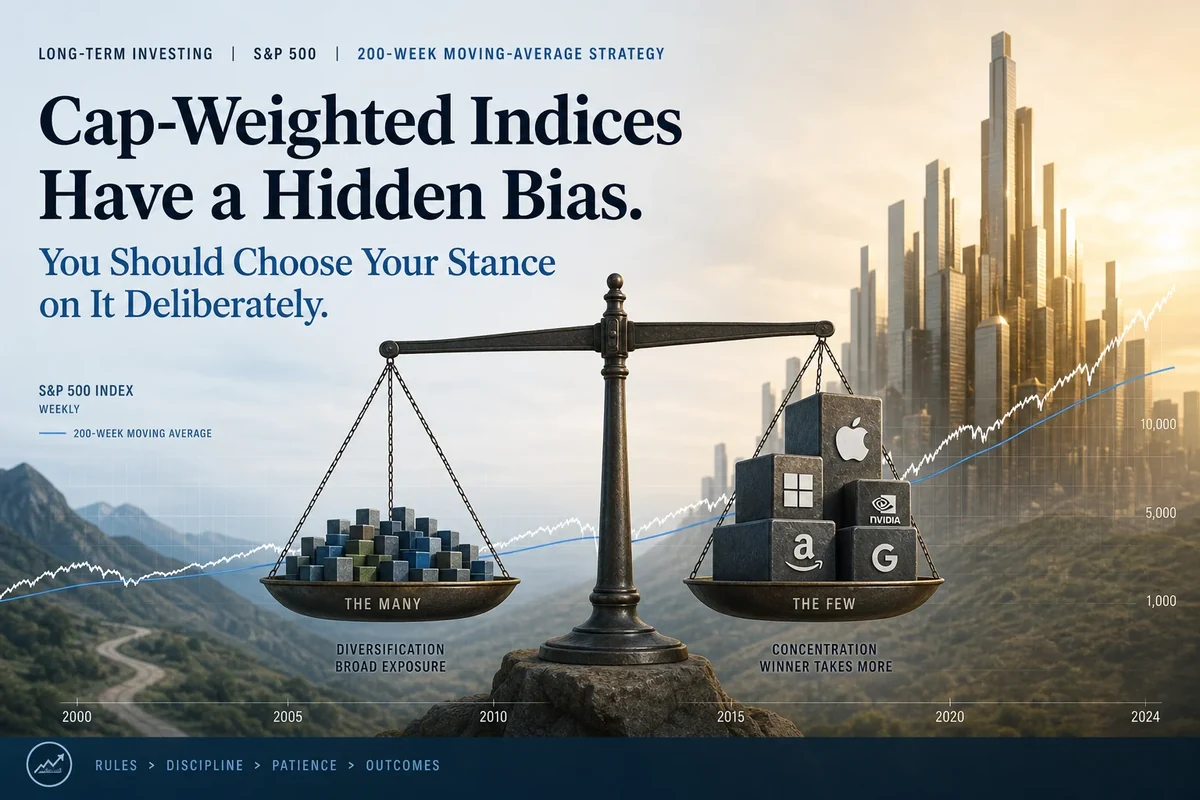
Most investors who own an S&P 500 index fund believe they own a diversified slice of the American economy. They do, but with a wrinkle that deserves conscious thought rather than passive acceptance. Cap-weighted indices are not neutral. They are, by construction, a bet that yesterday’s biggest winners should also receive the most capital tomorrow. Understanding that bias does not necessarily mean abandoning the cap-weighted structure, but it does mean you should arrive at it deliberately rather than by default.
What Cap Weighting Actually Does to Your Portfolio
Each company’s share of the portfolio in a cap-weighted index is proportional to its total market value. Apple’s weight equals Apple’s market cap divided by the combined market cap of all 500 companies. As Apple’s price rises, its weight grows automatically, with no action required from the index or the investor. As its price falls, its weight shrinks.
The practical consequence is that capital flows relentlessly toward whatever the market has most recently priced as valuable. A company trading at sixty times earnings receives three times the portfolio weight of a company trading at twenty times earnings, even if the cheaper company is twice as large by revenue, employees, or assets. Mathematically, cap weighting assuredly gives additional weight to stocks that are currently overpriced relative to their discounted future cash flows, and reduces weight in stocks trading below fair value. That observation comes from foundational research into alternative index construction, and it is not a controversial claim.
The result is that a standard S&P 500 fund carries a persistent growth and momentum tilt that is not stated in the prospectus but is embedded in the structure. You are not buying 500 companies equally. According to Pensions and Investments, the ten largest S&P 500 holdings now account for nearly 40% of the index, a concentration level near historical extremes. The remaining 490 companies share the other 60%. If you thought you were diversified across five hundred businesses, the math says otherwise.
The Momentum Tilt Nobody Signed Up For
Cap weighting is not the same as momentum investing, but it behaves similarly during periods of narrow market leadership. When a small group of large-cap technology companies dominates returns, as happened through much of the 2010s and into the mid-2020s, the cap-weighted index naturally concentrates more and more capital into those names without any rebalancing or active decision. Investors who added money throughout that period were, without realising it, buying increasing proportions of the highest-priced companies in the market.
Cap weighting is a systematic process of buying more of what has already risen. It is not the same as buying quality, and it is not the same as buying value. It is buying size, and size is determined by price.
This structure carries an asymmetric consequence. When a mega-cap company rises from 3% of the index to 7%, every new dollar invested in an S&P 500 fund is 7% exposed to that single company’s future. When that company eventually mean-reverts, whether through competition, regulatory pressure, or simply the gravity of its own valuation, the cap-weighted investor holds the largest possible position at the worst possible moment. Research into index construction covering more than four decades of US equity history found that the cap-weighted reference portfolio, compared with fundamentals-based alternatives, had a marked bias in favour of high-multiple stocks with strong perceived growth opportunities. Whether that growth bias proves profitable depends entirely on whether the market’s growth assumptions prove accurate.
The current environment gives that observation some urgency. The Shiller CAPE ratio for the S&P 500 stands at approximately 41x, a reading in the top percentile of recorded history. The Buffett indicator, which compares total US equity market capitalisation to GDP, sits near 139%. Both signals suggest the market as a whole, and particularly the cap-heavy concentration in a handful of technology companies, may be pricing in assumptions that leave limited margin of safety. The S&P 500 itself currently trades at a trailing P/E of 26.4x, compared with roughly 22.7x for the equal-weighted version of the same index. Same five hundred companies, meaningfully different valuations.
What Fundamental Indexation Proposes Instead
The most rigorous academic challenge to cap weighting came in research published in the Financial Analysts Journal by Robert Arnott, Jason Hsu, and Philip Moore in 2005, which introduced what they called Fundamental Indexation. The core argument was that if price is noisy relative to true fair value, then anchoring portfolio weights to price amplifies that noise. A better approach anchors weights to measures of actual economic size: revenue, book value, dividends, cash flow, or employment.
Their analysis covered more than four decades of US equity data. The cap-weighted reference portfolio grew one dollar invested in 1962 to approximately $68.95 by 2004. Fundamental indexes, depending on the metric used, grew that same dollar to between roughly $131 and $184. The composite fundamental index, blending multiple measures, ended near $156. These figures come from backtested simulations rather than live fund performance, and they span a specific historical period, so they should not be read as a guarantee of future outperformance. The excess returns were statistically significant across multiple subperiods and multiple metrics, with the composite index generating an average CAPM alpha of approximately 2.44% annually on a beta-adjusted basis, at a t-statistic of 3.87. That is not a noisy result, though the caveat about simulation versus live performance deserves genuine weight.
The researchers were careful about the explanation. Some of the outperformance plausibly reflects exposure to the value and size factors, which are themselves associated with additional risk. Some may reflect genuine market mispricing. They were agnostic between the two interpretations, concluding only that the excess returns appeared real and persistent across diverse market conditions, not artifacts of data mining. A Fama-French three-factor regression showed that after accounting for value and size exposures, the net alpha from fundamental weighting was effectively zero, meaning most of the excess return can be attributed to a structural value and small-cap tilt rather than to fundamental weighting as such. That is an important nuance: fundamental indices appear to work in part because they systematically own cheaper and smaller companies than a cap-weighted benchmark, not because they possess any additional forecasting ability.
Equal Weighting: Simpler but Not Straightforward
Equal weighting is the most intuitive alternative. Give every company in the index the same weight, roughly 0.2% for each of the 500 companies in the S&P 500, and rebalance quarterly to restore that equality. This eliminates the concentration problem entirely and introduces a natural contrarian discipline: each rebalancing trims winners and adds to laggards, the structural equivalent of buying low and selling high.
Some evidence in the literature suggests that the equal-weighted S&P 500 has tended to outperform the cap-weighted version over long historical periods, though the margin and consistency vary depending on the time window examined. Live data illustrates the valuation gap today. The Invesco S&P 500 Equal Weight ETF (RSP) currently trades at a trailing P/E of approximately 22.7x versus SPY’s 26.4x, and a price-to-book ratio of 1.42x versus SPY’s 1.72x. The equal-weight approach is currently cheaper on both measures, reflecting the valuation premium concentrated in the largest names.
The trade-offs are genuine, though. Equal weighting requires more turnover, as every quarterly rebalance means selling recent winners and buying recent laggards. That generates friction costs and, in taxable accounts, potential capital gains. Equal-weight indices also carry meaningfully higher exposure to mid-cap and smaller large-cap companies, which have historically delivered higher long-run returns but with more volatility. During periods of sustained mega-cap leadership, equal-weight indices underperform significantly, as happened across stretches of 2023 and 2024 when a handful of technology companies drove the overwhelming majority of S&P 500 gains. An investor in RSP during those years owned the same names in much smaller proportions, and trailed the cap-weighted index by a wide margin. That tracking error is real and persistent during periods of concentrated leadership.
The Structural Trade-Offs in Plain Language
Cap weighting offers low cost, minimal turnover, high liquidity, and near-zero tracking error against the benchmark that most institutional performance measurements use. It is the structure that lets a trillion-dollar index fund operate with minimal friction. Its embedded growth tilt has been highly rewarding during the long period of declining interest rates and technology dominance that characterised the 2010s. A long-term passive investor who held a cap-weighted S&P 500 fund for the past two decades has done extremely well, even accounting for concentration.
Fundamental weighting offers a structural value and size tilt, lower sensitivity to speculative excess in mega-cap names, and evidence of long-run excess returns, though at the cost of higher fees, more turnover, and the willingness to deviate from the cap-weighted benchmark over multi-year periods. The RAFI index family and similar products make this approach accessible in ETF form globally.
Equal weighting offers the simplest form of true diversification across all index constituents, natural contrarian rebalancing, and lower current valuations than cap weighting. It works best during periods when returns are broad-based across market-cap sizes rather than concentrated in a small number of mega-caps. It struggles during concentrated leadership phases, carries higher turnover costs, and requires quarterly rebalancing to maintain its structure.
None of these approaches is wrong. Each embeds a different set of assumptions about how markets work and where future returns will come from. The question is whether your current exposure reflects a deliberate choice or simply a default you have never examined.
One way to think about the current environment specifically: with the CAPE ratio at 41x and the top ten S&P 500 holdings accounting for nearly 40% of the index, the cap-weighted S&P 500 is more concentrated in expensive companies than it has been for most of its history. That does not mean those companies will underperform, but it does mean the cap-weighted investor is making an implicit bet that they will not. Investors who are uncomfortable with that concentration have liquid, low-cost tools to express a different view without abandoning passive investing entirely.
Making the Decision on Purpose
A baseline that deserves genuine respect is a low-cost, total-market cap-weighted index fund. For most investors with long time horizons and no particular view on valuations, this remains an excellent default. The evidence for passive investing over active management is overwhelming, and the cap-weighted structure captures the full market return with minimal friction. Many long-term investors using strategies like the Buy the 200 approach pair this core holding with a long-cycle technical signal to manage re-entry after drawdowns, reducing the risk of adding capital at peak concentration without requiring any stock-level forecasting.
For investors who are genuinely concerned about current concentration levels and are willing to accept tracking error against the cap-weighted benchmark, an equal-weight or fundamental-weight allocation to a portion of their equity exposure is a coherent position. It is not a prediction that mega-caps will fall. It is an acknowledgment that paying 26x earnings for the largest component of an index, when the equal-weight version of the same index is available at roughly 23x, is a choice, and that choosing the less expensive version of the same five hundred companies is not obviously irrational.
If you want to understand how the S&P 500 has behaved across full market cycles, including how the long-cycle trend interacts with valuation dynamics, the history of the S&P 500’s 200-week SMA provides useful context on how market-cap dynamics play out across decades rather than quarters.
The most important step is simply to know what you own. A cap-weighted index fund is not a neutral slice of the economy. It is a portfolio that tilts toward whatever has risen most, concentrates more than a third of your equity exposure in ten companies, and will continue to do so as long as those companies keep rising. That may be exactly the right strategy for you. It may not. Either way, it should be a position you have arrived at on purpose.
Frequently Asked Questions
Q: Isn’t buying the biggest companies simply buying the best companies?
A: Not necessarily. Size in a cap-weighted index reflects current market price, not underlying business quality or fundamental value. A company can be the largest by market cap while trading at a valuation that leaves little room for future returns. Research into fundamental indexation found that the cap-weighted list of largest companies had a consistent bias toward high-multiple, high-perceived-growth stocks relative to companies ranked by revenue, book value, or earnings, and that this growth bias had not proved profitable over multi-decade backtests.
Q: Does switching to equal weight mean I’m trying to beat the market?
A: Not in the traditional sense. Equal weighting is still a passive, rules-based strategy. You are not picking stocks or timing sectors. You are simply choosing a different weighting methodology for the same underlying universe of companies. The structural value and small-cap tilt that results may or may not outperform the cap-weighted benchmark in any given period, but the approach does not require active forecasting. It is a different form of passive investing, with different embedded assumptions about where long-run returns will come from.
Q: How much higher are the costs for equal-weight or fundamental-weight approaches?
A: The cost premium has narrowed considerably. Broad cap-weighted index ETFs commonly charge expense ratios well below 0.10%. Equal-weight and fundamental-weight ETFs typically charge somewhere in the range of 0.20% to 0.40%, reflecting the higher rebalancing turnover required to maintain non-market weights. Over a thirty-year holding period, even a modest annual cost difference compounds meaningfully, so the excess-return case for alternative weighting needs to be weighed against this friction. In tax-deferred accounts the turnover cost is less critical, in taxable accounts the rebalancing can trigger capital gains that erode the advantage further.
Q: Should I abandon cap-weighted index funds entirely?
A: That is rarely the right conclusion. Even investors who want to reduce concentration risk typically keep cap-weighted index funds as the core of their portfolio and use alternative-weight structures as a complement or a tilt. The cap-weighted structure remains the most liquid, lowest-cost, and most tax-efficient way to own a broad equity market. The question is not whether to own it, but whether to own it exclusively, and at what allocation, given your views on current valuations and the concentration it embeds at this point in the market cycle.