№ 004 · Strategy · · 10 min
Index Funds vs. ETFs: The Choice Most Investors Get Backwards
Most investors assume ETFs are automatically the better choice over index mutual funds. The reality depends on account type, tax situation, and how you actually behave as an investor.

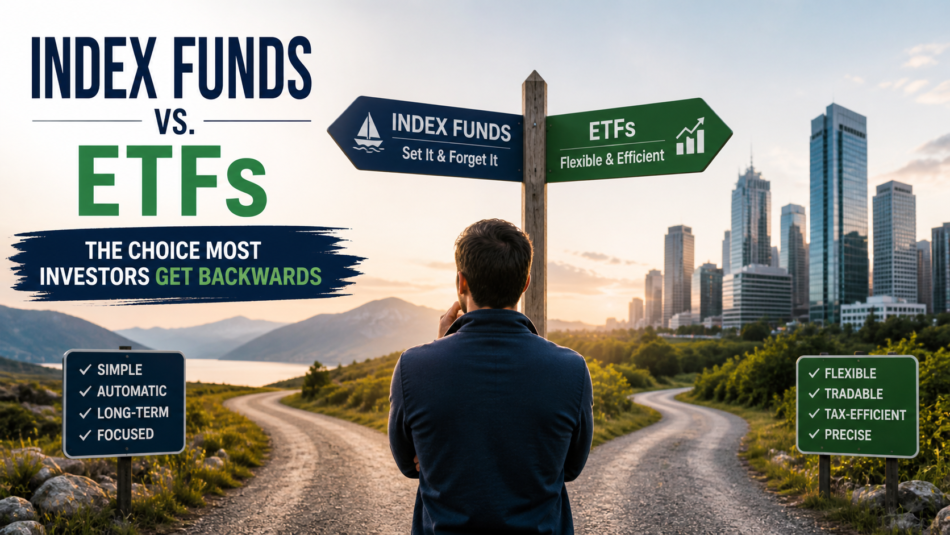
The internet has largely made up its mind: ETFs won. They are newer, they trade like stocks, their expense ratios look lean on a comparison table, and every financial content site has spent the better part of a decade declaring them the future of investing. The index mutual fund, in this narrative, is a relic, something your parents held in a 401(k) before anyone knew what a basis point was.
This framing is too simple, and for a meaningful slice of serious long-term investors, it leads to the wrong decision. The real question is not which wrapper is generically superior. It is which wrapper is better for your specific account type, contribution pattern, tax situation, and behavioral tendencies. When you break the comparison down that way, the mutual fund wins more often than the current consensus suggests.
Two Wrappers, One Underlying Reality
Start with what both vehicles actually are. An index fund, whether structured as a mutual fund or an ETF, is simply a pool of securities that tracks a stated benchmark. A Vanguard S&P 500 index mutual fund and a Vanguard S&P 500 ETF hold nearly identical portfolios. The same stocks, in the same weights, governed by the same rules. The benchmark does the heavy lifting. The wrapper determines how you access the portfolio, how it is priced, and in taxable accounts, how gains are distributed to you.
This point is worth sitting with. If you hold a low-cost S&P 500 index fund and a low-cost S&P 500 ETF for twenty years in a tax-sheltered account and never touch either, the pre-tax outcome will be nearly indistinguishable. The debate over wrappers is primarily a debate about cost delivery, tax mechanics, and the friction of using each vehicle. It is emphatically not a debate about which index to own.
Two investors can own the same 500 companies in the same proportions and still end up with meaningfully different after-tax outcomes, depending entirely on which wrapper they chose and which account they put it in.
The Tax Efficiency Argument: Real but Conditional
The strongest case for ETFs rests on a genuine structural advantage: the in-kind creation and redemption mechanism. When large institutional investors, called authorized participants, want to create or redeem ETF shares, they do so by exchanging baskets of the underlying securities with the fund. Because no cash changes hands inside the fund during this process, the ETF almost never needs to sell securities to meet redemptions. Fewer internal sales mean fewer realized capital gains, which means fewer taxable distributions passed to shareholders.
Index mutual funds handle redemptions differently. When investors sell their shares, the fund typically sells securities to raise cash. If those securities have appreciated over time, the fund realizes a gain, which it must distribute to all remaining shareholders at year end, including shareholders who never sold a single unit. This creates the uncomfortable situation where you can hold an index fund in a flat year, never trade it once, and still receive a taxable capital gain distribution because other investors in the fund redeemed.
This is a real cost in a taxable account. Research on major index mutual fund families shows that capital gain distributions have historically been modest for broad market index funds, since index funds trade less than active funds. But they are not zero, and in years following periods of heavy redemptions, they can be noticeable. The ETF structure largely eliminates this specific risk.
The critical qualifier is taxable accounts. Hold either wrapper inside a tax-sheltered structure, whether that is a 401(k), IRA, ISA, or equivalent, and the capital gain distribution mechanism becomes irrelevant. Gains compound inside the wrapper without triggering current tax regardless of how the fund handles redemptions internally. The ETF’s structural tax advantage simply does not apply there.
Expense Ratios: The Race to Zero Has Been Largely Won
A decade ago, ETFs often carried lower expense ratios than their mutual fund equivalents. That gap has compressed dramatically. Vanguard, Fidelity, Schwab, and BlackRock have driven headline expense ratios on broad index products to levels that are functionally equivalent across structures. Fidelity’s zero-expense-ratio index mutual funds, launched in 2018, represent an extreme case: for investors using those products in tax-sheltered accounts, the mutual fund structure actually carries a lower stated cost than any comparable ETF.
For most investors comparing major providers, the expense ratio difference between a large index ETF and the equivalent index mutual fund from the same firm is measured in single basis points, if there is a difference at all. A one or two basis point gap compounds to almost nothing over a multi-decade holding period. If anyone tries to sell you on an ETF primarily on the basis of a 0.01% expense ratio advantage over a comparable index mutual fund, the conversation has moved from analysis into marketing.
The more meaningful cost comparison involves transaction costs. Many brokerages allow investors to buy index mutual funds from affiliated providers with no commission and at no bid-ask spread. ETFs trade on exchanges and carry a bid-ask spread on every transaction, even if broker commissions are now zero at most major platforms. For small, frequent investments, this spread cost adds up in a way that the expense ratio headline does not capture.
Intraday Liquidity: Feature or Bug?
ETFs trade continuously throughout the market day at a price determined by supply and demand, anchored near net asset value by arbitrage activity. Index mutual funds price once at end of day, at the exact NAV. This difference is presented almost universally as an advantage for ETFs. More flexibility, faster access, tighter execution.
For a long-term investor with a ten-year-plus horizon, this framing deserves scrutiny. Intraday tradability is genuinely valuable if you need to execute a large rebalancing trade at a specific price, or if you are managing a complex multi-asset portfolio where timing matters. For the investor contributing monthly to a retirement account and reviewing the portfolio once a quarter, intraday liquidity provides no measurable benefit.
Intraday liquidity is not inherently valuable. Its value depends entirely on whether you have a legitimate reason to act intraday. For most long-term investors, the honest answer is no.
More troublingly, intraday liquidity creates temptation. The ability to sell an ETF at 10:32 a.m. on a Monday after a bad weekend of news is frictionless in a way that calling your fund company to redeem mutual fund shares is not. Behavioral finance research consistently shows that reducing transaction friction increases transaction frequency, and increased transaction frequency is negatively correlated with long-term investor returns. The mutual fund’s end-of-day pricing and its slightly higher redemption friction are, for investors with a known tendency to overtrade or panic-sell, an underappreciated protective mechanism.
Automatic Investments and Fractional Shares
One of the most practical advantages the index mutual fund retains is seamless automatic investment. Most brokerages allow investors to set up recurring purchases of mutual fund shares in exact dollar amounts, down to the cent. If you want to invest a fixed dollar amount every month, the mutual fund delivers the entire sum to work immediately, with no remainder sitting uninvested.
ETFs trade in whole shares. A broad market ETF priced at several hundred dollars per share means that a modest monthly contribution may leave a noticeable cash balance uninvested until you accumulate enough to buy the next whole share. Some brokerages now offer fractional ETF shares, which addresses this problem directly, but fractional share programs are not universal and vary by platform.
For investors using dollar-cost averaging as their primary strategy, which is the correct strategy for most accumulation-phase investors, this matters. The mutual fund structure removes the friction entirely. Every contribution goes to work in full, on schedule, without requiring you to log in and manually place a trade.
When the Mutual Fund Genuinely Wins
Synthesizing the above, the index mutual fund is the better structural choice under several specific conditions. First, when the account is tax-sheltered. Inside a retirement account, the ETF’s tax efficiency advantage is neutralized. The mutual fund’s convenience features for automatic investing then tip the balance in its favor. Second, when the investor has a history of behavioral overtrading. The mutual fund’s once-daily pricing removes the opportunity to react to intraday noise. Third, when using institutional or admiral share classes. Some large providers offer institutional-class index mutual fund shares with expense ratios that match or beat comparable ETFs, accessible at reasonable minimums. Fourth, when making regular small contributions. The mutual fund eliminates bid-ask spread costs and the fractional share problem for investors who invest monthly in fixed dollar amounts.
The ETF wins in a taxable account over a long horizon, particularly for a lump-sum investor who is not making regular fractional contributions and who has the discipline not to trade unnecessarily. It also wins when the investor needs to hold a position across multiple account types and wants a single, unified vehicle they can buy on any platform without fund-family restrictions.
The better question is never “ETF or mutual fund?” It is “what account am I using, how am I contributing, and how do I actually behave when markets fall?”
The Decision Framework in Practice
For most investors, the practical answer looks something like this. In a tax-sheltered retirement account where you are making monthly automatic contributions, use an index mutual fund from a low-cost provider. The convenience and behavioral guardrails are worth more than intraday flexibility you have no use for. In a taxable brokerage account where you invest larger, less frequent sums and value tax efficiency, use an ETF tracking the same index. If you are building a globally diversified portfolio across multiple asset classes and want maximum flexibility across platforms, ETFs are the more portable vehicle.
Neither answer involves the S&P 500 performing differently based on your wrapper. The index is the index. What changes is the efficiency with which the gains reach you after costs, taxes, and your own behavior are accounted for. That is what the wrapper debate is actually about, and it is a much narrower debate than the ETF-has-won narrative implies.
The investors who get this decision backwards are typically those who chose ETFs for a tax-sheltered automatic investment account because ETFs sound more sophisticated, or who hold index mutual funds in a taxable account because that is what they started with and never reconsidered. Both are avoidable errors with straightforward fixes. Match the wrapper to the account type and contribution pattern, keep costs low regardless of structure, and focus most of your attention on the things that matter far more: asset allocation, savings rate, and the discipline to stay invested through volatility.
Frequently Asked Questions
Q: If I hold both an ETF and an index mutual fund tracking the S&P 500, will one outperform the other over twenty years?
A: In a tax-sheltered account, the difference will almost certainly be negligible if both carry similar expense ratios. In a taxable account, the ETF will likely produce a modestly better after-tax outcome due to fewer capital gain distributions, though the magnitude depends on how often other fund investors redeem and how much the fund’s underlying holdings have appreciated.
Q: Is it true that some index mutual funds now have lower expense ratios than comparable ETFs?
A: Yes. Fidelity’s zero-expense-ratio index mutual funds are the clearest example. Vanguard also offers institutional-class mutual fund shares with expense ratios that match its ETFs once you meet the asset threshold. The idea that ETFs are structurally cheaper no longer holds as a blanket statement.
Q: Does the bid-ask spread on ETFs really matter for a long-term investor?
A: It matters most for investors making frequent small contributions. For a monthly dollar-cost averager buying a major broad-market ETF, spread costs accumulate across dozens of transactions per year. For a lump-sum investor making one or two transactions annually in a highly liquid ETF, the spread is minimal. Check the average spread on your specific ETF before dismissing this cost.
Q: Can I use both structures in the same portfolio?
A: Absolutely, and many investors should. A common approach is to use index mutual funds for automatic monthly contributions inside a retirement account, and ETFs for any taxable investing where tax efficiency is a priority. The two structures are not mutually exclusive, and matching each to the context where it performs best is more useful than picking one and applying it everywhere.