№ 006 · Strategy · · 10 min
The Passive Investing Paradox: Why It Works Until Everyone Does It
Passive investing's greatest strength is also its theoretical vulnerability: the more investors who abandon price discovery, the less efficient markets become. Here is how seriously to take that concern.

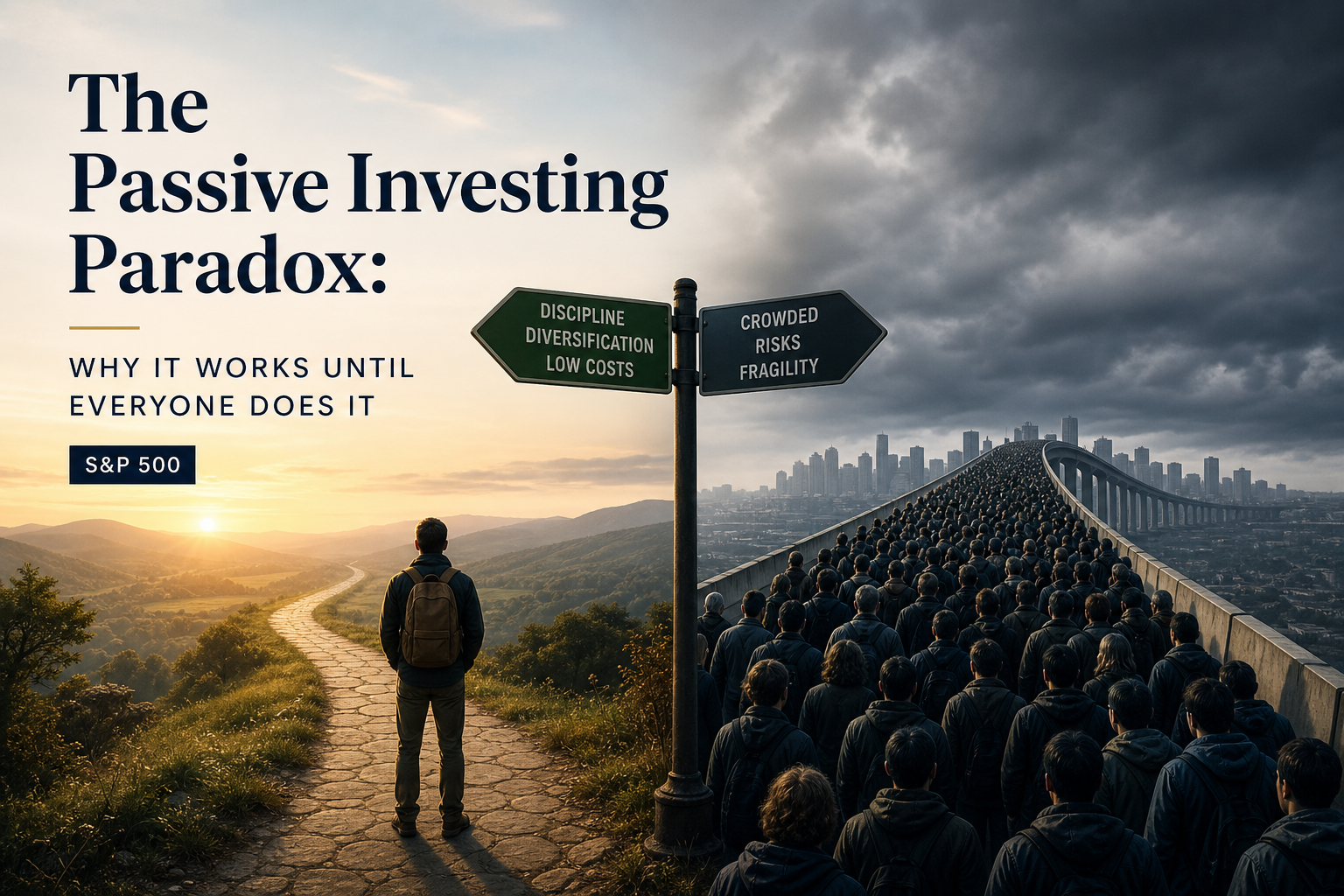
There is a thought experiment that every serious index investor should sit with honestly. If passive investing works because markets are efficient, and markets are efficient because active investors do the analytical work of pricing securities, then what happens when almost everyone goes passive? Who does the work? And if nobody does the work, do markets stay efficient enough for passive investing to keep working?
This is not a fringe concern invented by active fund managers defending their fees. It is a real and important question rooted in one of the most respected ideas in financial economics. Understanding it clearly, including where it is persuasive and where it falls short, is something every thoughtful long-term investor owes themselves.
The Grossman-Stiglitz Problem
In 1980, economists Sanford Grossman and Joseph Stiglitz published a paper that created what became known as the Grossman-Stiglitz paradox. The argument was elegant and uncomfortable: if markets were perfectly efficient, then prices would already reflect all available information, which means no investor could profit by doing research. But if no investor can profit from research, no rational investor would pay to do it. And if nobody does the research, prices stop reflecting information accurately. Markets cannot be perfectly efficient in equilibrium, because perfect efficiency destroys the incentive to produce the information that creates efficiency.
Markets need to be just inefficient enough to reward the analysts and traders who make them efficient. The passive investor free-rides on that work. The question is whether the free riders are becoming too numerous to sustain the system.
This paradox was largely theoretical for its first few decades. Active management dominated fund flows, and the concern stayed inside academic journals. Then came the sustained, data-driven shift toward index funds. Assets in passive U.S. equity funds crossed roughly 50% of total U.S. equity fund assets by the early 2020s, a threshold that felt symbolically significant even if the number itself was debated in terms of precise methodology. Commentators began asking whether the tipping point was approaching.
What Passive Ownership Actually Means for Price Discovery
The most important distinction to understand is the difference between ownership share and trading volume. Price discovery does not happen through who holds a stock. It happens through who is actively buying and selling at the margin. A passive index fund that holds Apple shares and never trades them contributes nothing to price discovery on a day-to-day basis, but it also causes no harm to the pricing mechanism during that same period. The active traders, including hedge funds, quantitative strategies, institutional desks, and individual stock pickers, are the ones whose transactions set the marginal price.
Research by economists including Antti Petajisto has examined what fraction of trading volume is attributable to truly active strategies versus passive or quasi-passive strategies. The conclusion, broadly, is that active trading remains the dominant source of volume even as passive ownership of assets has grown substantially. This is partly because active funds trade far more frequently than their ownership share would suggest, and partly because hedge funds, proprietary trading desks, and market makers operate at very high velocity relative to buy-and-hold index funds.
In other words, price discovery is more about the intensity of active participation than about the raw ownership percentage of passive funds. A market where 50% of assets are held passively but active participants trade those assets aggressively can still function with reasonable efficiency. The analogy is a city where half the residents commute by rail and half by car. The rail passengers are not causing traffic jams simply by existing.
Has Active Management Improved as Passive Has Grown?
If the paradox were operating at a meaningful scale, we would expect to see a detectable improvement in active manager performance as passive ownership rose, because less competition for mispricings should mean more mispricings available to skilled active managers. This is a testable prediction. The evidence, so far, does not strongly support it.
Research on active fund performance relative to benchmarks has not shown a clear trend of improving alpha as passive share has risen. The majority of active managers have continued to underperform their benchmarks net of fees across most time horizons and most market categories, roughly consistent with what the data showed before the passive revolution accelerated. If anything, the persistence of active underperformance in a world of growing passive ownership is itself evidence that price discovery remains reasonably competitive, because skilled managers are still not finding a growing pool of obvious mispricings to harvest.
This does not mean the paradox is wrong. It may simply mean we have not yet crossed the threshold where passive ownership becomes large enough to meaningfully impair price discovery. Or it may mean that the non-fund active participants, the hedge funds, the arbitrageurs, the quantitative traders, are sufficient to maintain efficiency even as retail and institutional long-term money increasingly sits passively. The honest answer is that we do not know where the threshold is, and we have not reached a level of passive ownership that has produced clear empirical deterioration in market quality.
The Concentration Problem: A More Immediate Concern
While the efficiency paradox remains largely theoretical at current ownership levels, there is a more immediate structural concern that deserves serious attention: cap-weighting concentration. The major cap-weighted indices, including the S&P 500 and MSCI World, automatically overweight the largest companies. As passive inflows grow, capital flows mechanically into the largest stocks regardless of their valuations. This creates a feedback loop where the biggest companies attract the most passive capital, which supports their prices, which makes them larger, which attracts more passive capital.
This dynamic does not break market efficiency in the Grossman-Stiglitz sense, but it does mean that passive investors in cap-weighted indices carry more concentration risk than the broad diversification of a 500-stock fund might imply. By the mid-2020s, the top ten holdings in the S&P 500 represented a historically elevated share of the total index weight, driven largely by the growth of a handful of large technology and platform companies. A passive investor buying the S&P 500 is not equally exposed to 500 companies. The index is deeply top-heavy, and that is a legitimate portfolio consideration regardless of what one believes about efficiency.
The efficiency paradox is the interesting theoretical concern. The concentration risk is the practical one that index investors should actually be managing today.
What Buffett Would Say, and Why He Still Recommends Index Funds
Warren Buffett has publicly recommended low-cost S&P 500 index funds for most investors on multiple occasions, most notably in his 2013 shareholder letter and repeatedly in his annual meetings. This is worth noting because Buffett is not naive about markets. He understands the Grossman-Stiglitz logic. His view, essentially, is that the alternative, paying active manager fees in exchange for statistically likely underperformance, is a worse outcome for most investors even in a world where passive ownership has grown substantially.
Buffett’s own approach at Berkshire Hathaway is pure fundamental analysis: find businesses with durable competitive advantages, buy them at reasonable prices, and hold for years or decades. This is exactly the kind of active, disciplined, long-horizon work that theoretically keeps prices anchored to underlying value. His willingness to recommend index funds to ordinary investors is not a contradiction. It reflects the practical reality that most investors lack the time, temperament, and skill to replicate that process, and that paying someone else to attempt it historically produces poor results on average.
The Grossman-Stiglitz framework suggests that investors like Buffett are essential to the system. Markets need people willing to do deep work and take concentrated positions based on research. The concern is not that such investors exist. They clearly do, in abundance. The concern is whether they will remain numerous enough, and their capital large enough, to keep prices honest as passive assets continue to grow.
How Worried Should a Long-Term Index Investor Actually Be?
The honest calibration, based on available evidence, is that the theoretical concern is real but the practical concern is currently modest. Several factors support a measured view. First, passive ownership of total market assets, not just mutual fund assets, remains well below 50% when the full universe of institutional owners, sovereign wealth funds, endowments, pension funds with active mandates, hedge funds, and individual stock owners is counted. The 50% figure applies narrowly to U.S. equity mutual fund and ETF assets, not to all equity ownership globally.
Second, the speed and sophistication of the remaining active participants has increased substantially. Quantitative and algorithmic strategies can identify and trade on mispricings much faster than a human analyst with a spreadsheet. This increases the efficiency of price discovery per active participant, which partially compensates for any decline in the total number of active participants.
Third, even if passive growth eventually does impair efficiency at the margins, the impairment would likely manifest as slightly wider mispricings and slightly more persistent anomalies, not as a catastrophic failure of markets to incorporate information. The practical implication for a long-term investor holding a diversified index fund would be modest. It would not eliminate the long-run case for owning productive assets through low-cost vehicles.
The passive investor is not destroying the system. She is benefiting from it, at a low cost, and doing so responsibly as long as a critical mass of active participants remains to sustain price discovery.
The threshold at which passive ownership genuinely impairs market function remains unknown. It may be 70% of total assets, or 80%, or it may depend so heavily on the quality and velocity of remaining active participants that a simple ownership percentage is the wrong frame entirely. What can be said with confidence is that the current level of passive ownership does not appear to have produced measurable deterioration in the markets’ ability to incorporate information efficiently.
The Practical Takeaway for Portfolio Construction
For a long-term investor building and maintaining a diversified portfolio, the passive investing paradox is worth understanding but not worth acting on through dramatic portfolio changes. The appropriate response is not to abandon index funds in favor of active management, which the historical record does not support as a superior strategy for most investors. The appropriate response is to hold index funds with clear eyes about their structural characteristics.
That means being aware of the concentration that cap-weighting produces and considering whether a simple S&P 500 or MSCI World fund represents the full diversification a portfolio needs, or whether some allocation to equal-weight strategies, small-cap exposure, or non-U.S. markets would provide meaningful diversification of the top-heavy risks that passive flows have amplified. It also means remaining genuinely humble about what is knowable. The passive revolution is a decades-long structural shift, and its second and third-order effects on market structure will take many more years to become fully legible.
The Grossman-Stiglitz problem is a reminder that no investing strategy is truly free. Passive investors are subsidized by the active work of others. That is not a moral failing. It is a structural reality. As long as the subsidy remains available because active participants continue their work, the long-term, evidence-based case for low-cost index investing remains intact.
Frequently Asked Questions
Q: Does the rise of passive investing mean markets are becoming less efficient?
A: Not clearly, at least not yet. Academic research has not found strong evidence that market quality has deteriorated in proportion to passive ownership growth. Active trading volume, which is what actually sets prices at the margin, remains high relative to the passive ownership share of total assets.
Q: If everyone went passive, would markets break?
A: In theory, yes. If no one did the analytical work of pricing securities, prices would stop reflecting information, and the premise of efficient markets that makes passive investing sensible would collapse. In practice, the relevant question is where the threshold is, and current evidence suggests we are not close to it.
Q: Should I shift to active funds to help support price discovery?
A: No. The decision about active versus passive should rest on expected net-of-fee returns and your own skill and time. Active funds have historically underperformed passive benchmarks on average over long periods. Contributing to price discovery is not a meaningful reason to pay higher fees for statistically likely underperformance.
Q: Is cap-weighting concentration a bigger practical risk than the efficiency paradox?
A: For most long-term investors today, yes. The efficiency paradox is a real theoretical concern for the future. Cap-weighting concentration, where the top handful of companies make up a historically large share of popular indices, is a present and measurable portfolio risk worth actively considering in how you construct and diversify your holdings.