№ 027 · Market Analysis · · 12 min
Which Equity Sectors Actually Pass Inflation Through to Earnings
Not every sector that rises in an inflation narrative actually protects your earnings. Here's the sector-by-sector evidence on pricing power, and why the story often misleads.

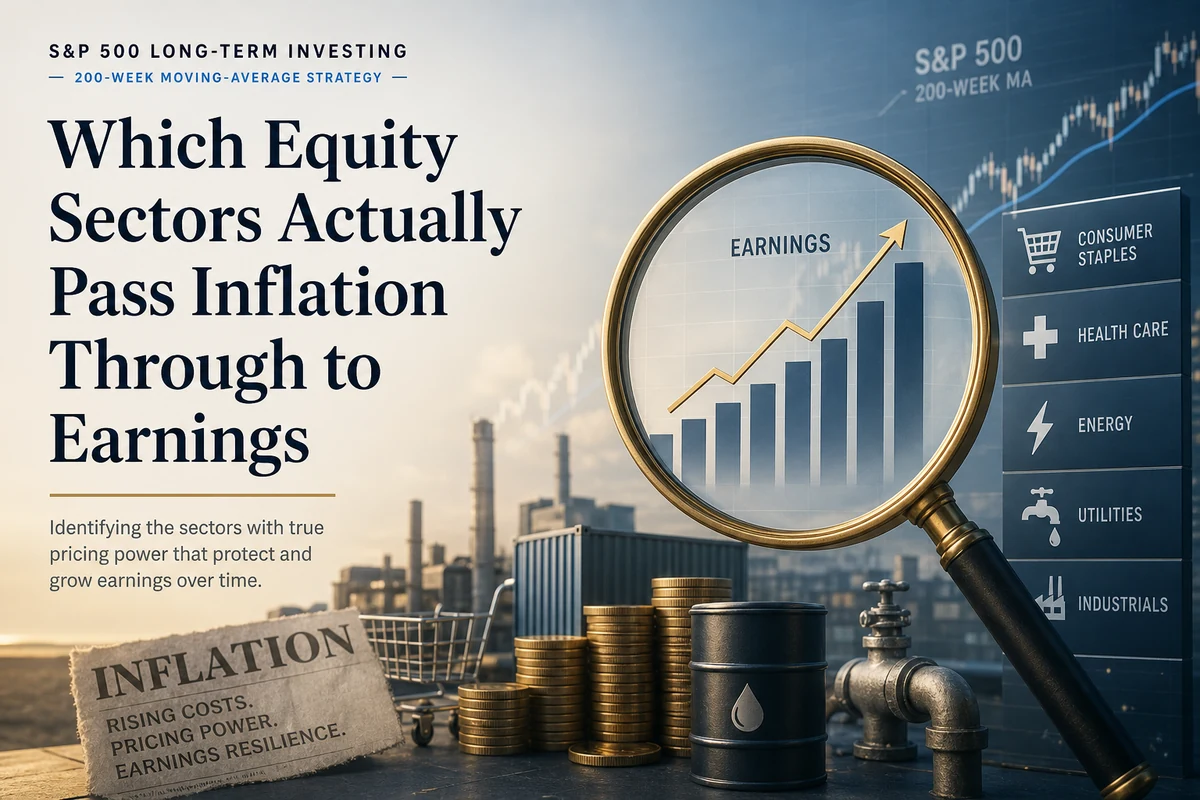
Inflation is one of those investing topics where the narrative and the data point in almost opposite directions. The standard advice runs something like this: buy energy stocks, buy commodities, buy real assets. They go up when inflation goes up. That much is sometimes true. But there is a deeper and more useful question that rarely gets asked: which companies actually convert rising prices into rising earnings, rather than simply experiencing higher revenue that evaporates into higher input costs? The difference between the two is what determines whether inflation protects your purchasing power or simply creates the illusion of it.
What Inflation Pass-Through Actually Means
Pass-through is not the same as revenue growth. A company that sells oil at $100 a barrel instead of $70 earns more revenue, but if its extraction, transportation, and capital costs have also risen, the margin expansion is modest at best. True pricing power means something more specific: the ability to raise prices faster than your own cost structure rises, thereby expanding margins even when the macro environment is hostile. That is a property of individual businesses and their competitive positions, not of sectors as a whole.
The clearest way to measure it is gross margin stability across inflation cycles. A company whose gross margin holds or expands during an inflationary period has genuine pass-through capability. One whose gross margin compresses is simply a revenue vehicle for inflation, not a real earnings protector. This distinction matters enormously for long-term investors, because real earnings growth, not nominal revenue, is what ultimately drives equity returns above inflation.
The question is not whether a sector’s revenues rise with inflation. The question is whether that inflation reaches earnings without being consumed by costs along the way. Most sector-level narratives confuse the two.
Consumer Staples: The Pass-Through Case Study
Consumer staples companies are often described as defensive, which investors tend to interpret primarily as low volatility. But the more important property is structural: these businesses sell products people continue buying regardless of economic conditions, at price points they adjust upward incrementally. Because the volume decline from a price increase is typically modest for habitual household products, the business absorbs cost increases without sacrificing unit economics.
Procter and Gamble is the clearest illustration. The company carries an operating margin of around 23% and a return on assets above 10%, sustained across conditions that have included the post-pandemic inflation surge, supply chain disruptions, and significant commodity input cost increases. The brand strength behind names like Tide, Gillette, and Pampers means customers absorb price increases without switching to generics in sufficient volume to damage earnings. The free cash flow, currently running above $12 billion annually, reflects a business that translates nearly every dollar of price increase into cash, not one whose gains disappear into raw material costs.
The pattern holds broadly across well-managed consumer staples companies. Brand loyalty, high purchase frequency, and the relatively small share of household budgets occupied by any single product all contribute to a cost structure that passes price increases through without triggering the demand destruction that would erode volumes. That is the mechanism. The sector label is secondary to whether an individual company within it actually possesses these characteristics.
Software and High-Margin Technology: The Quiet Beneficiary
The conventional inflation hedging narrative almost never includes software, yet high-margin software businesses may be among the most structurally protected in a sustained inflationary environment. The reason is straightforward: their primary cost is human capital, particularly engineers and developers. Labor costs do rise with inflation, but for companies whose gross margins run well above 60 percent, a meaningful increase in labor costs still leaves operating margins largely intact.
Microsoft is an instructive example, though outcomes for any individual holding depend on the valuation at which it is purchased. With an operating margin of approximately 46% and free cash flow above $37 billion annually, the company’s cost structure is fundamentally dominated by labor rather than physical inputs. Enterprise software customers do not switch platforms to avoid a 5 or 10 percent annual price increase because the switching costs, measured in disruption, retraining, and integration work, far exceed the incremental cost of renewal. That switching cost is effectively a moat against the demand destruction that undermines pricing power in other sectors.
This is the category Buffett has described most consistently when discussing businesses he admires: companies that require little incremental capital to maintain or grow their earnings, and that can raise prices without losing customers. Software with deep enterprise integration fits that description closely. The inflationary environment does not generate headline excitement around these companies the way it does for oil producers, but the earnings resilience is measurably superior over full cycles.
Energy and Commodities: The Pass-Through Illusion
Energy stocks attract enormous attention during inflationary periods for obvious reasons: oil and gas prices rise, revenues surge, and share prices follow. The 2021 to 2022 inflation cycle was a vivid example, with energy the only major S&P 500 sector to post strong positive returns in 2022 while almost everything else declined. This performance creates a compelling narrative about energy as an inflation hedge.
The problem is what happens over a full cycle. Energy companies are price-takers on their primary product. They cannot set the price of oil, they receive whatever the market offers. When the commodity cycle reverses, as it does with reasonable regularity, the earnings that looked so durable disappear. Exxon Mobil, one of the better-managed majors, currently carries an operating margin of roughly 6.4% and a return on assets of approximately 4.2%, both figures reflecting the reality that upstream energy is an inherently thin-margin business when measured across time rather than at a cyclical peak. The company’s earnings in 2020 were deeply negative. Its 2022 earnings were enormous. Neither figure tells you much about durable pricing power.
What this means practically is that energy exposure provides commodity price exposure, not earnings quality. It is a bet on the oil price cycle, which may or may not coincide with the inflationary period you are trying to hedge against. Supply shocks and demand cycles have their own timing, and they do not reliably track headline inflation in the ways investors assume when they buy energy as protection.
A commodity producer’s revenues rise with inflation in the commodity, but that revenue comes from a price set by global markets, not by the company. Pricing power requires the ability to set your own price. Commodity producers, almost by definition, cannot do that.
Healthcare and Pharmaceuticals: Complex but Often Underrated
Healthcare is a sector where genuine pricing power exists alongside genuine risk of its removal. Branded pharmaceutical companies with protected products can and do raise prices independently of inflation, often by amounts that significantly exceed it. That is a form of pricing power so strong that it has attracted sustained political scrutiny in the United States and regulatory intervention in many other markets.
The more durable part of the healthcare inflation story sits in medical devices, diagnostics, and healthcare services with sticky patient populations. These businesses combine recurring revenue, modest commodity input intensity, and a customer base whose demand is not meaningfully price-elastic. A patient requiring a specific diagnostic test or a hospital system needing specialized equipment is not particularly sensitive to a 5 percent annual price increase. That inelasticity, combined with relatively stable cost structures, creates a category of healthcare businesses whose gross margins hold reasonably well across inflation cycles.
The risk specific to healthcare is regulatory, not competitive. Governments retain the ability to impose price controls or reimbursement reductions that can override pricing power quickly. This is a ceiling on the thesis that does not apply to most other sectors, and investors who treat healthcare as straightforwardly inflation-proof without accounting for political risk are taking on an exposure that gross margin analysis alone will not reveal.
Utilities and Real Estate: The Rate Compression Problem
Utilities are frequently cited as inflation beneficiaries because many operate under regulatory frameworks that allow them to apply for rate increases when input costs rise. This is a real mechanism, but it comes with two important limitations. First, the regulatory approval process introduces a lag between when inflation hits and when a utility can recover it through approved rate increases. Second, utilities are long-duration assets whose valuations are highly sensitive to interest rates. Inflation and rising rates tend to arrive together, as the current environment with the 10-year Treasury yield above 4.5% illustrates, and the rate-driven valuation compression often offsets or exceeds whatever earnings benefit the utility eventually captures through rate approvals.
Real estate sits in a similar position. Landlords can, in principle, raise rents with inflation, and lease structures in commercial and industrial property often include inflation escalators. In practice, occupancy risk, lease duration, and the interest rate sensitivity of property valuations create a more complicated picture. The real estate investment that genuinely protects against inflation is one where rents can be repriced frequently, in markets with strong demand relative to supply. That describes a narrower slice of the real estate universe than the category broadly suggests.
Why the Sector Narrative Misleads Long-Term Investors
The most persistent error in thinking about inflation and sectors is treating sector membership as a sufficient condition for protection when it is at best a rough prior. Within any sector, the distribution of pricing power is wide. There are consumer staples companies with weak brands that cannot pass through costs. There are energy companies with such low-cost production that their margins are relatively stable across cycles. There are industrial companies with near-monopolistic positions in specialized components whose pricing power rivals anything in consumer brands.
A more useful framework starts with the business, not the sector. Four questions identify genuine pricing power: Does the customer have a realistic and reasonably cheap alternative? Does switching to that alternative impose meaningful cost or disruption? Does the company’s primary cost structure track the inflation it is trying to pass through, or does it tend to compress margins? And has the company demonstrated stable or improving gross margins across at least one prior inflationary period? Companies that answer favorably on all four dimensions possess real pass-through capability. Those that answer favorably on one or two are often sector beneficiaries rather than pricing-power businesses.
For long-term index investors, the good news is that the S&P 500 contains a substantial weighting toward businesses with structural pricing power, particularly in technology, healthcare, and consumer brands. Passive ownership of the index captures that distribution. The Buy the 200 strategy uses the 200-week moving average as a long-cycle signal for broad market entry, and the logic there complements the inflation-resilience argument: entering the market when it is trading near or below its long-run trend means you are buying the index’s earnings power, including its inflation-resilient components, at more attractive prices. How that signal has behaved across past market cycles is covered in detail at the S&P 500 200-week SMA history page.
At current valuations, with the Shiller CAPE at approximately 41.9x and the 10-year yield above 4.5%, the market is not priced to offer easy nominal returns from here regardless of sector. The argument for quality, pricing-power businesses is strongest in this environment not because they will necessarily outperform short-term, but because their real earnings are most likely to survive a period of sustained above-average inflation without the kind of mean-reversion that hits cyclical or commodity-dependent earnings hard. Valuation at time of purchase still matters, even for the best businesses, but the structural characteristic of genuine pass-through capability is where the analysis has to start.
Inflation protection in equities is not about owning a sector. It is about owning businesses that can raise their prices without losing their customers, and whose cost structures do not quietly absorb the gains before they reach earnings.
Frequently Asked Questions
Q: Is energy really not an inflation hedge if oil prices rise so strongly during inflationary periods?
A: Energy provides commodity price exposure, which can coincide with inflation but does not reliably do so over full cycles. Energy earnings in 2020 were deeply negative despite headline inflation not being in freefall. By contrast, consumer staples and software earnings remained positive. The hedge is short-term and cyclical, not durable. The question to ask is not whether the sector rises but whether the earnings survive after costs are deducted across the full cycle.
Q: How do I identify a company with genuine pricing power before an inflationary period hits?
A: Look at gross margin history across at least one prior inflationary cycle, ideally both the mid-2000s commodity surge and the 2021 to 2022 post-pandemic inflation. Companies whose gross margins held steady or improved during those periods demonstrated the mechanism, not just the outcome. Also consider switching costs: businesses whose customers face significant disruption from switching have a structural advantage that shows up most clearly when they test it with a price increase and volumes hold.
Q: Do index funds protect against inflation better than trying to pick inflation-resilient sectors?
A: For most investors, broad index ownership is the more reliable path. The S&P 500 is meaningfully weighted toward businesses with structural pricing power, and the cost of misidentifying inflationary beneficiaries through active sector rotation tends to be high. Evidence consistently indicates that most investors who rotate into inflation-sensitive sectors do so after the regime is established, which means they buy near the peak of the cycle’s pricing. Broad index ownership, maintained through a disciplined long-term strategy, captures the inflation-resilient businesses without requiring correct timing of the cycle.
Q: Are utilities a reliable inflation hedge given their regulated pricing structures?
A: Only partially, and with significant caveats. Rate increases in regulated utilities require approval and typically lag the inflation they are meant to recover. More importantly, inflation episodes usually coincide with rising interest rates, which compress utility valuations simultaneously. The net result is that utilities often underperform during the most intense phase of an inflationary cycle, even while their regulated revenues are eventually adjusted upward. They are more accurately described as low-volatility income vehicles than strict inflation hedges.