№ 015 · Education · · 13 min
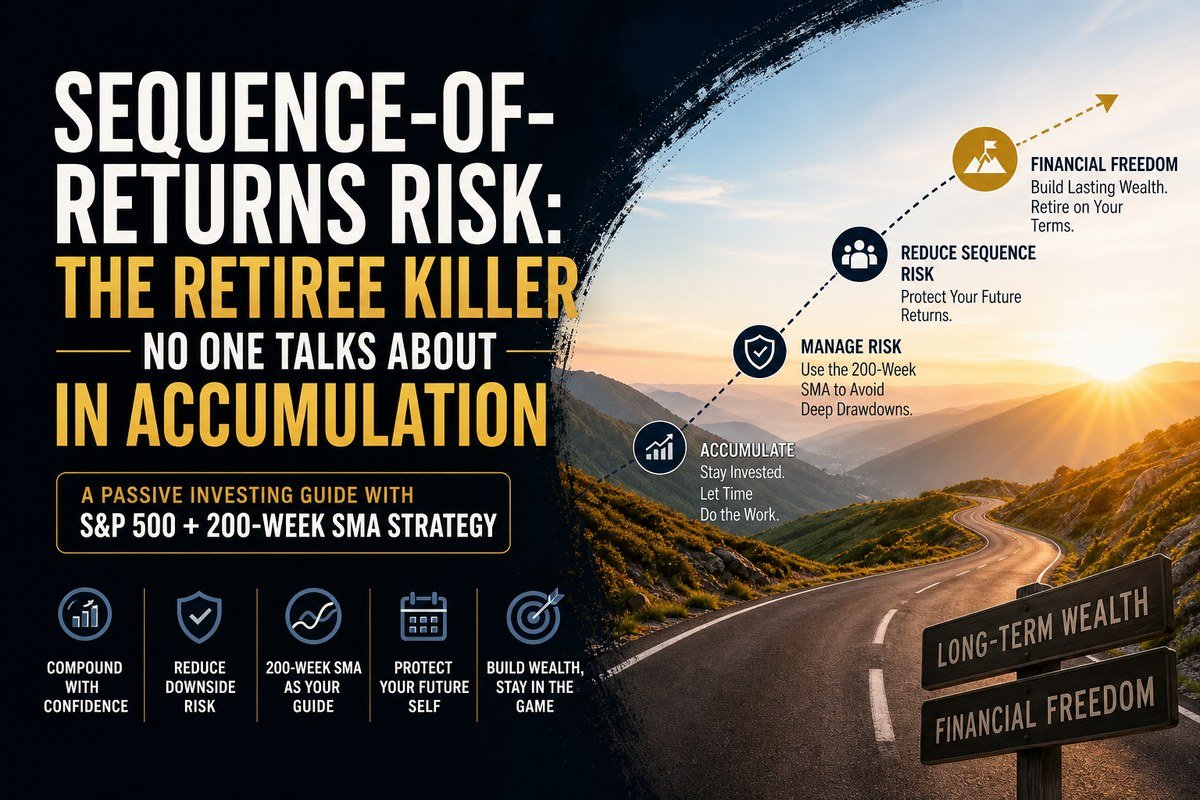
Sequence-of-Returns Risk: The Retiree Killer No One Talks About in Accumulation
Two retirees with identical average returns over 30 years can end up hundreds of thousands of dollars apart depending solely on when those returns arrive. Understanding sequence-of-returns risk is the most important thing a pre-retiree can do before drawing down a single dollar.

During the accumulation years, average return is a perfectly reasonable shorthand for how a portfolio is likely to grow. You invest, the market compounds, and the sequence in which individual years arrive barely matters. A 20% gain in year one followed by a 10% loss in year two produces almost exactly the same ending value as the reverse order, provided you never touch the principal. This mathematical symmetry is so intuitive that most pre-retirement planning tools are built around it.
The problem is that retirement is not accumulation. The moment you begin withdrawing capital, the symmetry breaks. Return order stops being irrelevant and starts being one of the most consequential variables in your entire financial life. Yet the standard retirement calculator, the default 60/40 glide path, and the ubiquitous “4% rule” presentation in most financial media treat average return as if order still does not matter. It does. Enormously.
Why “Average Return” Is a Lie Retirees Tell Themselves
The compound annual growth rate (CAGR) is a clean, useful number for investors who are adding to a portfolio. It collapses a volatile return history into a single figure that accurately predicts where a lump sum will end up if left untouched. The problem is that “left untouched” is precisely what retirement prevents.
Consider a simple illustrative framework drawn from the research literature on sequence risk. Suppose a portfolio earns returns that can be classified as High (+29.71%), Moderate (5%), or Low (-15%), with the numbers chosen deliberately so that one High year and one Low year combined return exactly 5% CAGR. Over a ten-year period containing two High years, two Low years, and six Moderate years in varying order, a buy-and-hold investor with no withdrawals ends up at the same place regardless of sequence. Every arrangement produces the same terminal value because the math is purely multiplicative.
Now introduce a retiree withdrawing $40,000 per year from a $1,000,000 starting portfolio. The research is unambiguous: final balances range from $887,000 to $1,244,000 depending solely on the order those returns arrive. That is a $357,000 gap from identical underlying CAGR. No average return figure surfaces this risk, because it genuinely cannot. The standard retirement calculator is, by construction, blind to it.
A retiree’s internal rate of return can be anywhere from -0.71% to +10.98% while the underlying portfolio CAGR remains a constant 5%. The gap is not a rounding error. It is sequence-of-returns risk made visible.
The Worst-Case Scenario Is an Early Bear Market
Most people intuitively understand that a market crash is bad for retirees. What they underestimate is the precise mechanism that makes early crashes categorically worse than late ones, and why the damage is permanent rather than recoverable.
When a retiree withdraws a fixed dollar amount during a down market, they must sell more shares to raise the same cash. A $40,000 annual withdrawal requires selling 40 shares of a $1,000 stock, but 80 shares of that same stock at $500. Those 40 extra shares are gone permanently. When the market recovers and the stock returns to $1,000, the retiree no longer owns those 40 shares. The recovery does not bring them back.
This is the inverse of dollar-cost averaging, which works in accumulation precisely because buying more shares when prices are low creates a benefit on the recovery. Withdrawing during low prices creates the same number of transactions with the exact opposite outcome. Research framing this problem directly notes: “Low returns early on are poison to your retirement finances. It’s the opposite of dollar-cost averaging; you sell more shares when prices are down.”
A late bear market is far less dangerous. By the time a significant decline arrives in year 20 or 25, the portfolio has had decades of growth and the retiree has fewer withdrawal years remaining. The asymmetry is not subtle. A bear market in years one through five is structurally more damaging than a bear market of identical magnitude in years twenty through twenty-five, even if the percentage drawdown is identical.
The Math: One Retiree Wins $357,000, Another Loses It
The $357,000 gap described earlier deserves a closer look because the mechanism is worth internalizing before choosing any mitigation strategy.
In the best-case sequence (High returns early, Low returns late), the retiree’s portfolio grows substantially before withdrawals begin eroding principal in earnest. The low-return years arrive when the portfolio is large enough to absorb them without severe share liquidation. In the worst-case sequence (Low returns early, High returns late), the retiree is forced to liquidate shares at depressed prices immediately. By the time the high returns materialize, the portfolio is materially smaller and there are fewer shares left to benefit from the recovery.
The IRR divergence in the research documentation is stark: from a 5% CAGR, retiree outcomes span roughly -0.71% to +10.98% in effective internal rate of return. This is not a difference of a fraction of a percent. This is the difference between a retirement that works and one that quietly fails, all while the average return figure on the account statement looks reasonable throughout. This is why sequence risk is called a “silent” risk. It does not announce itself. It compounds invisibly until, often too late, the trajectory becomes clear.
The Bond Tent: Insurance, Not a Performance Drag
The bond tent strategy is one of the most empirically defensible responses to sequence risk, and one of the most misunderstood. The name refers to a temporary overweight in bonds or other low-volatility assets during the early years of retirement, typically years one through seven, followed by a gradual return to a higher equity allocation as the sequence-risk window passes.
The misunderstanding usually sounds like this: “Bonds underperform equities over the long run, so holding more bonds in early retirement sacrifices returns.” This framing treats the bond tent as a performance allocation when it is actually an insurance contract. Its purpose is not to maximize expected return. Its purpose is to reduce the probability of being forced to sell equities at a loss during the most dangerous sequence-risk window.
Research into TIPS ladders as a sequence-risk hedge illustrates this clearly. Most of the time, a TIPS or bond ladder underperforms a 75/25 equity-bond portfolio. But in the scenarios that historically destroyed retirements, the ladder preserved capital that the equity portfolio could not. As the research notes: “That’s the nature of this Sequence Risk hedge: you do better in the worst-case scenarios, but you lose a little bit and leave a slightly less spectacular inheritance to your heirs when the market rallies during your first eight years of retirement. Most retirees are willing to pay this insurance premium.”
A practical bond tent might look like this: enter retirement at 50% equities and 50% bonds or fixed income, then glide back toward 75% equities over seven years as the acute sequence-risk period passes. This is not market timing. It is a pre-committed structural allocation designed specifically around the asymmetry of early retirement withdrawals.
The bond tent is not a drag on performance. It is the premium on an insurance policy that pays out precisely when you need it most and costs almost nothing in the scenarios where markets cooperate.
The Cash Buffer as a Sequence-Risk Escape Valve
A complementary approach to the bond tent is the cash buffer strategy: holding two to three years of planned withdrawals in cash or near-cash equivalents at all times during retirement. The logic is straightforward. If you never need to sell equities to fund withdrawals during a downturn, the forced-liquidation mechanism that drives sequence risk cannot operate.
When markets are down, you draw from the cash buffer. When markets recover, you replenish the buffer by trimming equities at higher prices. The portfolio is insulated from at least two to three years of adverse returns without any liquidation of depressed assets.
Critics of the cash buffer note, correctly, that cash earns low real returns and creates a drag on the overall portfolio in normal market conditions. This is true. But the relevant comparison is not “cash versus equities in a bull market.” The relevant comparison is “cash buffer in the worst historical sequences versus no buffer in the worst historical sequences.” In the latter framing, the drag during good years is small relative to the benefit during sequences that would otherwise be catastrophic.
The cash buffer and bond tent are not mutually exclusive. Many thoughtful retirement frameworks combine both: a two-year cash buffer for immediate liquidity, a bond tent for medium-term protection across years three through seven, and a high equity allocation for the remainder of the portfolio that captures long-run compounding once the acute sequence-risk window is past.
Dynamic Withdrawal Rules Beat the Static 4% Approach
The 4% rule originated from research into safe withdrawal rates for 30-year retirements and has since become the dominant mental model for retirement income planning. It is not wrong exactly. But it is a blunt instrument applied to a problem that rewards precision.
The core limitation of a static withdrawal rate is that it ignores feedback. It does not adjust when the portfolio underperforms early, and it does not increase when the portfolio outperforms. Both failures have costs. In a bad sequence, continuing to withdraw 4% regardless of portfolio value accelerates the depletion that sequence risk has already started. In a good sequence, the static rule leaves money untouched that could have improved quality of life or been given away.
Dynamic withdrawal rules address this by conditioning the withdrawal amount on portfolio performance. A common approach uses the portfolio value at the ten-year mark as a checkpoint. If the portfolio has held within a reasonable range of the initial capital in inflation-adjusted terms, withdrawals can continue at the original rate. If the portfolio has declined significantly, a modest reduction in withdrawals can meaningfully extend portfolio life. Research suggests that conditional rules based on portfolio value at decade boundaries reduce tail-risk uncertainty substantially compared to static approaches.
The specific thresholds matter less than the principle: regular recalibration, even once per decade, dramatically improves outcomes in adverse sequences because it interrupts the compounding of early damage. A 10% reduction in withdrawals during a bad sequence in years six through ten can be the difference between a portfolio that recovers and one that does not.
Sequence Risk Does Not Expire After the First Decade
One of the most persistent misconceptions in retirement planning is that sequence risk is a front-loaded problem. Get through the first five to ten years without a major bear market, the thinking goes, and you are safe. This is partially true but fundamentally incomplete.
Research into the structure of sequence risk describes a self-similar pattern that operates at each decade boundary throughout retirement. After the first ten years of returns become history, the next ten years become the dominant source of sequence risk for the remaining retirement period. The same asymmetry that made early bear markets so damaging in years one through ten re-emerges in years eleven through twenty, then again in years twenty-one through thirty.
The analogy used in the research literature is Mandelbrot’s fractal geometry: zoom in at any decade boundary and the same structure reappears. This is not a comforting insight for those who assumed they had escaped sequence risk after surviving the first decade intact. Strictly speaking, sequence risk is present for the entire duration of withdrawals.
This does not mean that every decade is equally dangerous. The early years remain the highest-risk period because the portfolio is largest and the compounding damage is greatest. But the often-repeated claim that sequence risk is irrelevant after year ten is incorrect, and planning around that assumption leaves the middle and later decades of a long retirement underprotected.
The Safe Withdrawal Rate You Actually Need
The standard presentation of the 4% rule applies to a 30-year retirement horizon. For early retirees or those with significant longevity, the relevant horizon is 50 to 60 years. The fail-safe withdrawal rate changes meaningfully as the horizon extends.
Research using historical S&P 500 and 10-year Treasury data estimates that for a 60-year retirement horizon with a 75% equity and 25% bond allocation, the fail-safe withdrawal rate is approximately 3.25%. To sustain $40,000 per year in real withdrawals under the worst historical scenarios, the required starting capital is approximately $1,229,000. For a 30-year horizon, the required capital drops to approximately $1,047,000 for the same $40,000 annual withdrawal.
The difference between a 30-year and 60-year retirement is not merely time. It is an additional $182,000 in required starting capital to maintain the same withdrawal amount safely, before considering the compounding effects of any adverse sequence in the first decade.
One particularly sobering finding from this research: moving from a 60-year to a 50-year horizon reduces the required fail-safe capital from $1,229,000 to $1,194,000, a reduction of only about 3%. The fail-safe capital requirements for long retirements compress tightly because the fail-safe scenario is always defined by the worst historical sequence, and the worst sequences tend to cluster in the early years regardless of total horizon length.
For practical purposes, this means that anyone planning a retirement of 40 years or longer should treat 3.5% as a reasonable conservative target and 3.25% as the genuine stress-test benchmark, not 4%. The 4% rule is a useful starting point for a 30-year traditional retirement, not a universal prescription for everyone who plans to retire before 65.
The sequencing problem is ultimately about the interaction between timing and liquidity. Accumulation investors are shielded from it entirely because they have no mandatory outflows. Retirees face it constantly because every withdrawal is a forced transaction at whatever price the market offers. Recognizing this asymmetry, and building a retirement income structure that respects it, is not optional planning. It is the foundational task of retirement finance.
Frequently Asked Questions
Q: Does sequence-of-returns risk apply only in the early years of retirement?
A: Early retirement years carry the highest sequence risk because the portfolio is largest and forced share liquidation is most damaging. However, research shows that sequence risk re-emerges at each decade boundary throughout retirement. It is not a front-loaded problem that expires after year ten. A 60-year retirement has meaningful sequence risk in years one through ten, years eleven through twenty, and beyond.
Q: How does the bond tent differ from a traditional conservative glide path?
A: A traditional glide path continuously reduces equity exposure as retirement approaches and continues declining into retirement. The bond tent specifically increases bond allocation in the years just before and just after retirement, then deliberately rebuilds equity exposure over years three through seven. The shape is tent-like rather than monotonically declining. The purpose is targeted sequence-risk insurance during the highest-risk window, not a permanent reduction in growth exposure.
Q: Is the 4% rule still valid?
A: For a 30-year retirement with a diversified equity-bond portfolio, the 4% rule has held up through most historical periods. For early retirees with 50 to 60-year horizons, the historical fail-safe withdrawal rate is closer to 3.25%. Current equity valuations and low expected bond yields may further compress safe withdrawal rates. The 4% rule is a reasonable starting framework, not a guaranteed outcome, and it performs best when combined with dynamic adjustment rules rather than applied rigidly.
Q: Can a retiree ever truly eliminate sequence-of-returns risk?
A: Sequence risk can be mitigated substantially through bond tents, cash buffers, dynamic withdrawal rules, and supplemental income sources like Social Security or pensions that reduce reliance on portfolio withdrawals. It cannot be fully eliminated as long as retirement requires ongoing portfolio withdrawals. Strategies that completely insulate retirees from sequence risk, such as full annuitization, typically introduce other constraints including loss of liquidity and inflation exposure. The practical goal is meaningful reduction, not elimination.