№ 008 · Education · · 11 min
Rebalancing Is the Only Free Lunch You’re Guaranteed to Eat
Portfolio rebalancing rarely gets the credit it deserves. Done consistently and intelligently, it is one of the few disciplines in investing that genuinely works without requiring superior forecasting ability.

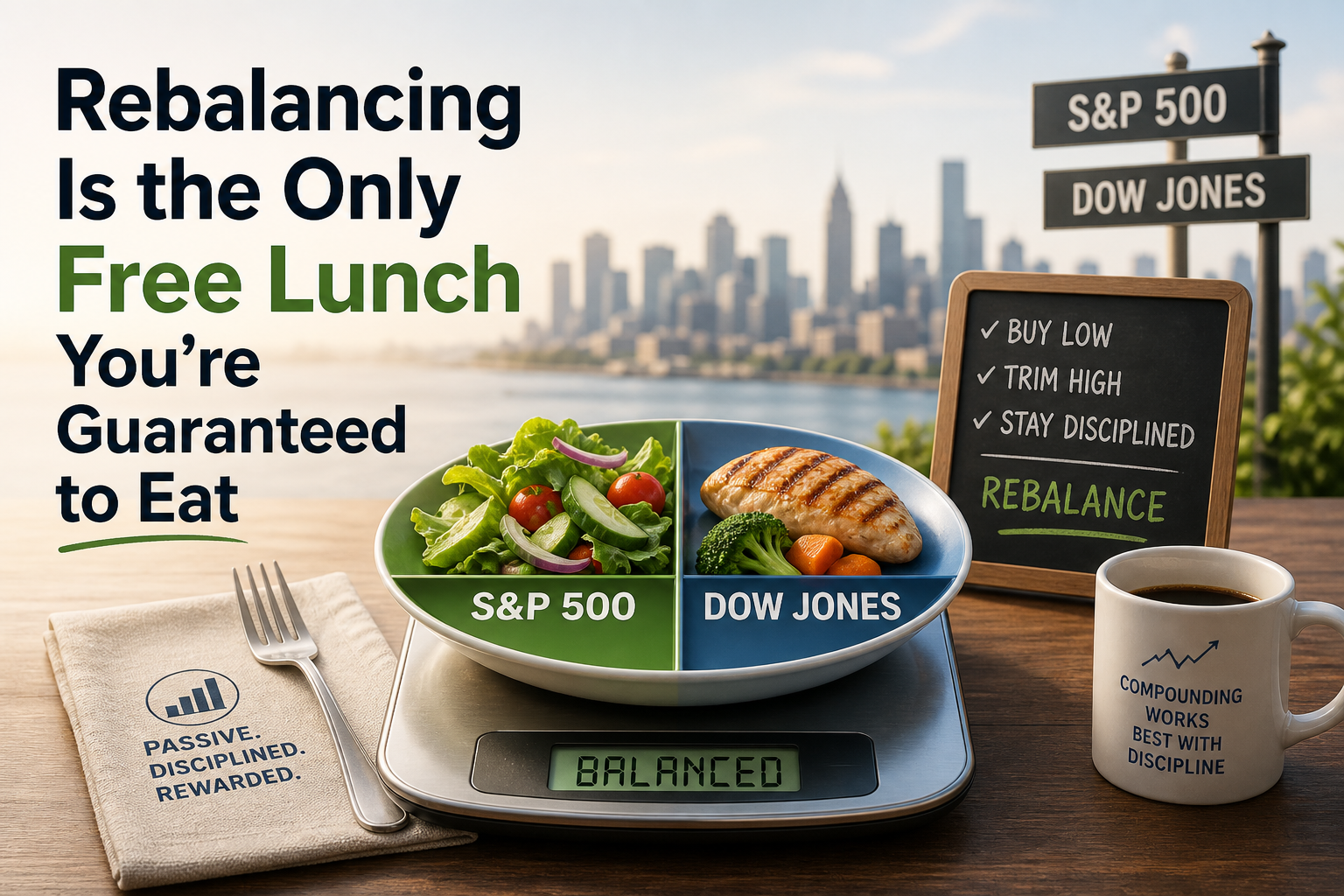
There is a phrase in finance that gets repeated so often it has nearly lost its meaning: “there is no free lunch.” The idea is that every extra unit of expected return comes attached to extra risk, extra cost, or extra effort. That is mostly true. But there is one practice that comes closer to a genuine exception than almost anything else in the discipline of portfolio management, and it is one of the least glamorous things you can do with your money. It is rebalancing.
Rebalancing does not require you to forecast the economy, identify undervalued securities, or time market cycles. It requires only that you decide in advance what your portfolio should look like, notice when it has drifted from that target, and take the steps to restore it. That sounds almost trivially simple. The reason most investors do not do it well, or do not do it at all, has almost nothing to do with the mechanics and almost everything to do with psychology.
What Drift Actually Costs You
To understand why rebalancing matters, you first have to understand what happens to a portfolio when you leave it alone. The short answer is that it drifts toward whatever has performed best recently, and that drift is not neutral.
Consider a straightforward starting allocation of 60 percent global equities and 40 percent bonds. In a prolonged equity bull market, a portfolio like this does not stay 60/40 for long. Research suggests that a portfolio constructed at 60/40 in the mid-2010s would have drifted well past 75/25 or even 80/20 by the early 2020s without any intervention, simply because equities significantly outperformed fixed income over that period. This is not a problem when equities keep rising. It becomes a very significant problem when they fall, because the investor is now carrying substantially more equity risk than they originally chose to accept.
This is the core issue with cap-weighted drift. As prices rise, you automatically accumulate more of what has become expensive and proportionally less of what has become cheap. The passive investor who takes genuine passivity to mean “do nothing ever” is not actually maintaining a passive strategy. They are running a momentum strategy by default, one that systematically adds exposure at higher prices and reduces it at lower ones, which is precisely the opposite of what disciplined long-term investing is supposed to accomplish.
An unmonitored portfolio does not stay balanced by accident. Over time, it drifts toward concentration in whatever has won most recently, which is rarely what you would have chosen deliberately.
The Rebalancing Premium: Real but Modest
Academic finance has spent considerable effort trying to quantify what rebalancing actually adds to returns. The honest summary is that the benefit is real, it is consistent across long historical periods, and it is not large enough to be the primary reason you rebalance.
Historically, a systematically rebalanced portfolio has tended to outperform a buy-and-hold portfolio by somewhere in the range of 0.1 to 0.5 percent per year on a risk-adjusted basis, depending on the asset classes involved, the rebalancing threshold used, and the time period studied. That is not a dramatic number. Over thirty years of compounding, however, it is meaningful. More importantly, the rebalanced portfolio consistently achieves this result with lower volatility and smaller maximum drawdowns, which is itself a form of return for investors who care about the actual experience of holding an investment.
The mechanism behind the premium is straightforward. Rebalancing forces you to sell assets that have risen in relative price and buy assets that have fallen. When asset classes mean-revert, as they historically have over long cycles, this systematic contrarianism captures some of that reversion as return. It is not guaranteed to work in every period, particularly in sustained trending markets where the winning asset class keeps winning for years. But over full market cycles, the evidence is reasonably consistent.
What rebalancing definitely delivers, regardless of whether the premium materialises in any given period, is risk control. You are continuously returning to the risk profile you originally chose. That is not a small thing.
Calendar Rebalancing Versus Threshold Rebalancing
Not all rebalancing approaches are equal. The two most commonly discussed methods are calendar-based rebalancing, where you rebalance at fixed intervals such as annually or quarterly, and threshold-based rebalancing, where you rebalance whenever any asset class drifts beyond a defined tolerance band, typically 5 percentage points from its target weight.
The research generally favours threshold-based approaches, and the reasoning is intuitive. Calendar rebalancing may force you to trade when nothing much has changed, incurring transaction costs and potential tax events for no meaningful benefit. It may also fail to act when markets move sharply between your scheduled intervals, meaning a 20 percent equity correction in month two of your annual cycle goes unaddressed until month twelve. Threshold rebalancing, by contrast, triggers action in proportion to actual portfolio drift.
A practical hybrid that many serious investors use is a combination of both: check the portfolio at regular intervals, but only rebalance if allocations have drifted beyond a defined band. This avoids unnecessary trading while ensuring you do not miss significant dislocations. For most long-term investors holding broad index funds, a 5 percent threshold is a reasonable starting point. A 10 percent threshold may be appropriate in taxable accounts where the cost of realising gains is high.
The transaction cost question is worth taking seriously. For investors using low-cost ETFs through a commission-free brokerage, the direct cost of rebalancing has fallen to nearly zero in recent years. What remains is the potential tax cost of selling appreciated assets in a taxable account, which brings us to the most important practical refinement in the entire discipline.
Tax-Aware Rebalancing: Keeping More of What You Earn
Rebalancing in a tax-deferred or tax-exempt account is uncomplicated. You sell what has grown too large, buy what has shrunk too small, and owe nothing to the tax authority until you eventually withdraw. The calculation is clean.
In a taxable account, the situation is more nuanced. Every sale of an appreciated asset creates a realised gain, which triggers a tax event. If you rebalance aggressively in a taxable account without any tax sensitivity, you may consume a significant portion of the rebalancing benefit in taxes paid today, in exchange for a benefit that is modest and spread over many years. This is not a reason to abandon rebalancing; it is a reason to be strategic about how you do it.
In a taxable account, new contributions are often the most powerful rebalancing tool available. Directing fresh capital toward underweight asset classes can restore balance without triggering a single taxable event.
The most tax-efficient rebalancing tools, roughly in order of preference, are: directing new contributions to underweight asset classes, reinvesting dividends and distributions into underweight positions, selling assets at a loss to harvest tax losses while simultaneously rebalancing, and finally, selling appreciated assets in taxable accounts only when the drift is significant enough to justify the tax cost. The first two tools should be used continuously and automatically, well before you ever need to reach for the fourth.
Asset location plays a related role here. Holding higher-turnover or higher-income assets such as bonds and real estate investment trusts in tax-sheltered accounts, while holding lower-turnover equity index funds in taxable accounts, reduces the rebalancing tax burden structurally. You end up doing most of your rebalancing activity where the tax cost is zero.
The Behavioural Value Is Not Optional
Everything discussed so far has been quantitative. The rebalancing premium, threshold bands, tax drag calculations. But the most important reason to rebalance systematically may have nothing to do with any of those numbers.
Rebalancing forces you to do the hardest thing in investing, which is to act against your recent emotional experience. When equities have risen for several years and feel safe, you sell some of them. When equities have fallen and feel terrifying, you buy more of them. When bonds have been delivering poor returns and feel pointless, you add to them. Every one of these actions runs directly against the narrative that the market and financial media are telling you at that moment.
A written investment policy statement that includes specific rebalancing rules converts this behavioural discipline from a virtue you have to summon under pressure into a procedure you simply execute. The decision to rebalance is made once, in advance, calmly. The execution happens mechanically when the conditions are met. This removes the most dangerous variable in long-term investing, which is your own emotional state during a market crisis or an extended bull run.
Vanguard’s research on advisor value has consistently found that behavioural coaching, which includes maintaining discipline during volatility, accounts for the largest single component of what a good advisor actually provides. Rebalancing is the most concrete, rule-based expression of that discipline that a self-directed investor can implement without any outside help.
Common Mistakes That Undermine the Process
Several errors are common enough to be worth naming explicitly. The first is treating rebalancing as optional during bull markets. Many investors maintain their rebalancing discipline through small corrections but abandon it after years of rising equity prices, reasoning that equities always go up and the 40 percent bond allocation is just drag. This is precisely the portfolio drift problem described earlier, and it tends to be corrected involuntarily by the next bear market.
The second mistake is over-engineering the approach. Some investors become so focused on optimising their threshold bands, minimising transaction costs to the last basis point, and tax-loss harvesting every minor fluctuation that rebalancing becomes a significant ongoing project rather than a periodic maintenance task. For most investors holding three to five broad index funds, a simple annual check with a 5 percent tolerance band is sufficient. The enemy of a good rebalancing plan is a perfect one that you never quite implement.
The third mistake is confusing rebalancing with tactical asset allocation. Rebalancing restores you to your target. It does not involve changing your target based on market conditions. If you start reducing your equity allocation because you think the market is too high, or increasing it because you think the entry point is attractive, you are no longer rebalancing. You are attempting to time the market, which is a different activity with a substantially worse historical track record.
Rebalancing is not a return-maximising strategy dressed up as risk management. It is a risk-management strategy that captures a modest return premium as a side effect. Understanding that distinction matters enormously when markets are moving in ways that make the rebalancing trade feel wrong.
Building a Rebalancing Policy You Will Actually Follow
The practical implementation does not need to be complicated. Write down your target allocations and your tolerance bands before the market does anything interesting. Decide whether you will use calendar checks, threshold triggers, or a hybrid of both. Decide which accounts will absorb the rebalancing activity, prioritising tax-sheltered accounts where possible. Decide how you will use new contributions to do rebalancing work passively before you ever need to sell anything.
Then put that policy somewhere you will see it when the market is down 30 percent and everything feels like it is falling apart, because that is precisely the moment when the policy needs to override your instincts. The rebalancing trade during a serious bear market feels catastrophic. You are selling bonds, which have held their value, and buying equities, which have been destroyed. Every news article you read will be telling you why equities will keep falling. The policy, written in calmer times, is your protection against the very reasonable-sounding arguments that will be made for abandoning the plan.
Rebalancing is not exciting. It does not generate the kind of stories that get shared in investing forums or discussed at dinner parties. It will not double your money in a year. What it will do, reliably and without requiring any particular skill or insight on your part, is keep your portfolio aligned with the risk level you chose, force disciplined contrarian behaviour over time, and capture whatever premium exists from systematic mean-reversion across asset classes. That is about as close to a guaranteed free lunch as this business offers.
Frequently Asked Questions
Q: How often should I rebalance my portfolio?
A: For most long-term investors, checking the portfolio once or twice a year and rebalancing only if any asset class has drifted 5 percentage points or more from its target is sufficient. Rebalancing more frequently than necessary adds transaction costs and potential tax events without meaningful additional benefit.
Q: Does rebalancing guarantee better returns?
A: No. Rebalancing is primarily a risk-control strategy, not a return-maximisation strategy. It historically captures a modest return premium by systematically buying low and selling high across asset classes, but this premium is not guaranteed in any given period. What rebalancing does reliably deliver is a portfolio that stays close to your intended risk level over time.
Q: Should I rebalance differently in a taxable account versus a retirement account?
A: Yes, significantly. In tax-deferred or tax-exempt accounts, rebalance freely when thresholds are breached. In taxable accounts, use new contributions and dividend reinvestment to rebalance passively first, and only sell appreciated assets when the drift is large enough to justify the tax cost. Locating higher-turnover assets in sheltered accounts also reduces the problem structurally.
Q: What is the difference between rebalancing and market timing?
A: Rebalancing restores your portfolio to a pre-set target allocation regardless of your views on the market. Market timing involves changing your target allocation based on forecasts or market conditions. The two activities feel similar when the rebalancing trade and the market-timing trade point in the same direction, but they are fundamentally different in both process and historical results. Rebalancing works; market timing has a poor track record for most investors.