№ 003 · Education · · 11 min
Charlie Munger’s Mental Models Every Long-Term Investor Should Internalize
Charlie Munger built his worldview on a latticework of mental models drawn from psychology, mathematics, and economics. Here is how each one applies directly to the mistakes long-term investors make most often.

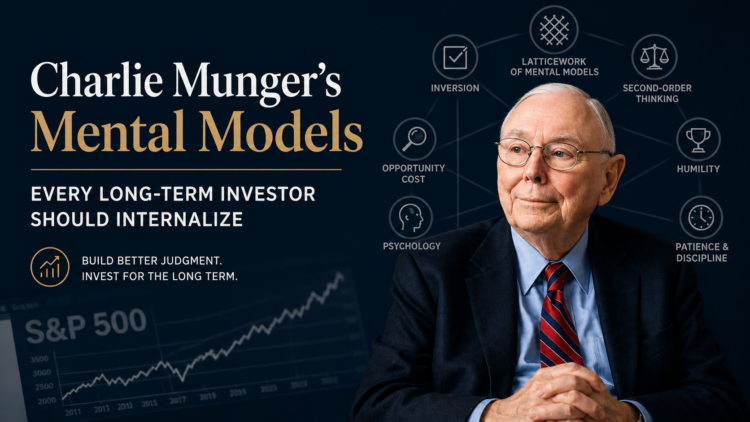
Charlie Munger spent decades arguing that the investing world over-indexes on finance and under-indexes on everything else. His solution was what he called a latticework of mental models: a collection of big ideas drawn from psychology, mathematics, biology, physics, and economics, held together so that each one reinforces the others. When you see a problem through several lenses at once, you are far less likely to be fooled by any single frame.
Munger was not a theorist. Every model he championed had a direct application to the kind of decisions that cost real investors real money. This article takes four of the most powerful models he taught and connects each one to specific portfolio mistakes that are, frankly, very common. The goal is not a biographical tribute. It is to give you tools you can use the next time a market narrative starts pulling you in a direction you have not fully examined.
Why Mental Models Matter More Than Market Rules
Most investing education teaches rules: diversify, rebalance annually, keep costs low, do not time the market. Rules are useful. But rules without underlying models are fragile. When the situation changes in a way the rule did not anticipate, the investor who only knows the rule is lost. The investor who understands the model beneath the rule can adapt.
Munger borrowed this insight partly from physics. A physicist does not just memorize formulas. She understands the principles behind them, which means she can derive the formula again if she forgets it and can recognize when the formula no longer applies. Investing is not physics, but the epistemological lesson transfers cleanly.
The latticework approach also acts as a check on overconfidence. When you hold multiple models, they compete with each other. A valuation model might say a stock is cheap. A psychology model might flag that you are anchoring to the price you paid. A second-order thinking model might reveal that everyone else already knows the stock is cheap, and has priced that in. Holding those three frames simultaneously produces a more honest conclusion than any one of them alone.
Inversion: Start With What You Are Trying to Avoid
Munger borrowed inversion from the German mathematician Carl Jacobi, who reportedly advised colleagues to “invert, always invert.” The idea is simple: instead of asking how to achieve a goal, ask what would guarantee failure, and then avoid those things systematically.
Applied to a long-term portfolio, inversion changes the entire framing of the exercise. Rather than asking “which funds will outperform over the next decade?”, you ask “what behaviors reliably destroy long-term wealth?” The answers are well-documented: excessive trading, high fees, concentration in narratives rather than businesses, panic selling at cycle lows, and leverage applied at the wrong time. If you simply avoid those behaviors, you have already outperformed a large share of active participants.
Inversion is especially powerful because it bypasses the optimism bias that distorts most forward-looking analysis. It is cognitively easier to identify catastrophic failure modes than to accurately forecast success, and it is often more profitable to do so.
A concrete application: before adding any new position to a portfolio, write down three specific ways that position could permanently impair capital, not temporarily decline, but permanently impair. If you cannot write three credible failure scenarios, you probably do not understand the position well enough to own it. This is not pessimism. It is rigor. Munger would say the same.
Opportunity Cost: The Tax Nobody Puts in the Prospectus
Munger described opportunity cost as one of the most underused ideas in finance. Every investment decision carries two costs: the explicit cost of what you pay, and the implicit cost of what you give up by not deploying capital elsewhere. Most investors track the explicit cost obsessively and ignore the second almost entirely.
Consider the investor who holds a poorly performing actively managed fund because “it has not lost money.” In absolute terms, that may be true. But if a globally diversified index fund tracking something like the MSCI World has compounded at a meaningfully higher rate over the same period, the managed fund has imposed a substantial opportunity cost. That cost never appears on a statement. It is invisible, which is exactly what makes it dangerous.
The opportunity cost model also argues against the common practice of holding excessive cash waiting for a “better entry point.” Research in behavioral finance consistently shows that investors who wait for clarity before investing tend to wait too long and miss a disproportionate share of compounded returns. The cost of that wait is real, even though no fee is charged for sitting on the sideline.
Munger applied this model at the individual security level too. He and Buffett famously evaluated every potential new investment against their existing best idea. If the new idea was not clearly better than what they already owned, capital stayed where it was. This is a discipline most retail investors never practice, because they evaluate each potential investment in isolation rather than against the alternatives already in their portfolio.
Lollapalooza Effects: When Biases Stack Up Together
The lollapalooza effect is perhaps Munger’s most original contribution to investment psychology. He used the term to describe situations where multiple cognitive biases and incentives all point in the same direction at once. When that happens, the resulting behavior is not just a little irrational. It becomes extreme, self-reinforcing, and very difficult to reverse.
Munger argued this pattern explains most financial manias and crashes. A typical bubble does not form because investors are simply greedy. It forms because greed is operating simultaneously with social proof (everyone around you is buying), availability bias (recent returns are vivid and easy to recall), commitment and consistency (you have already told people about the trade), and authority bias (prominent figures are endorsing the idea). Each bias alone might be manageable. All of them acting in concert produce behavior that looks, in retrospect, obviously deranged.
The lollapalooza effect is why rational individual investors can collectively produce irrational markets. Understanding it does not make you immune, but it does give you a diagnostic: when you notice several distinct reasons all telling you to do the same thing at the same time, that is precisely when you should slow down.
The practical application for a long-term portfolio is to treat unanimity as a warning sign rather than confirmation. When every financial publication, every analyst, and every conversation at a dinner party converges on the same conclusion, including the conclusion that a particular asset class is permanently broken and should be avoided, the lollapalooza machinery is running. In early 2009, near the bottom of the global financial crisis, the lollapalooza effect was operating in reverse: fear, recency bias, social proof, and loss aversion all pointed toward selling equities. Those who understood the model were better equipped to recognize what was happening and hold their position, or add to it.
Social Proof: The Most Respectable Cognitive Trap
Social proof is the tendency to look to others when we are uncertain about what to do. In most areas of life, it is a sensible heuristic. If you are new to a city and you see one restaurant full and the one next to it empty, the crowd is probably giving you useful information. In financial markets, the same behavior tends to be systematically destructive.
Markets are, by construction, a mechanism that incorporates the expectations of all participants into prices. This means that following the crowd is almost never an edge. By the time a consensus view is visible enough to guide your behavior, it has already been priced. The investor who buys a sector because it has been in every magazine for six months is not picking up information. She is picking up risk that has been repriced away from the people who held the narrative earlier.
Munger was particularly sharp on the version of social proof that operates through institutional channels. A pension fund manager who holds the same stocks as every other pension fund manager faces limited career risk even if returns are poor, because everyone suffered together. This incentive structure means that professional money management systematically rewards conformity and punishes independent thinking, even when independent thinking would produce better outcomes for clients. Understanding this helps explain why index investing, which sidesteps the conformity trap entirely, has such a strong long-run record against active management.
The antidote to social proof is not contrarianism for its own sake. Munger was not interested in being different. He was interested in being right. The discipline he advocated is to form a view from first principles before checking what the consensus believes, and then to hold that view long enough to let it be tested by evidence rather than by popularity.
Building the Latticework: How These Models Work Together
The real power of Munger’s framework is not in any single model but in the interaction between them. Consider a common scenario: an investor holds a significant position in a technology-focused fund that has delivered strong returns for several years, and is now debating whether to add more capital to it.
Inversion asks: what would guarantee the worst outcome here? Concentration in a single sector at peak sentiment, high valuations, and leverage would all qualify. Opportunity cost asks: compared to a low-cost global equity index, is this fund genuinely likely to add enough alpha to justify the concentration risk? Social proof caution asks: am I attracted to this fund partly because it has been widely celebrated, and would I have the same conviction if no one else were talking about it? And the lollapalooza frame asks: how many separate reasons am I telling myself to add to this position, and are they actually independent, or are they all downstream of the same narrative?
Running all four models does not always produce the same answer. Sometimes they genuinely point in different directions, and that tension is useful information. What they prevent, collectively, is the kind of unreflective momentum-driven decision that accounts for a large share of the performance gap between what markets return and what individual investors actually receive.
Munger’s latticework is not a checklist to run mechanically before each trade. It is a set of habits that, practiced consistently over years, changes how you perceive financial situations in real time. That is a compound return on intellectual investment that rivals anything the market offers.
Applying Munger’s Models to the Long Cycle
The 200-week moving average, which this site treats as a long-cycle positioning signal, is itself a kind of mental model: a systematic way of distinguishing secular trends from cyclical noise. Munger would likely have respected it as one useful lens among many, while cautioning against treating any single technical signal as a complete decision framework.
What the mental model approach adds to technical analysis is a layer of psychological hygiene. A signal tells you where price has been and, probabilistically, where momentum may carry it. It does not tell you why you are tempted to override it, what the opportunity cost of waiting for the signal is in a given environment, or whether the consensus interpretation of the signal has already been priced. The models help you answer those questions, which the chart alone cannot.
Long-term investors who combine disciplined valuation and cost awareness with a working knowledge of their own cognitive tendencies are, in Munger’s worldview, the most formidable players in any market. Not because they know more, but because they reliably make fewer large errors. Over a multi-decade compounding horizon, avoiding large errors matters at least as much as identifying large opportunities.
Frequently Asked Questions
Q: What did Munger mean by a “latticework of mental models”?
A: He meant building a toolkit of big ideas from many disciplines, including psychology, economics, mathematics, and biology, so that when you face a complex problem you can apply multiple independent frameworks rather than relying on one. The strength of the approach comes from the way the models check and reinforce each other.
Q: How does inversion differ from simple risk management?
A: Risk management typically tries to quantify the probability and magnitude of adverse outcomes. Inversion is more qualitative: it asks you to vividly imagine the specific behaviors and decisions that lead to failure, and to organize your strategy around avoiding them. It tends to surface non-quantifiable risks, such as behavioral errors, that standard risk frameworks miss.
Q: Is social proof always harmful in investing?
A: Not always. When a broad consensus reflects genuine fundamental value that has been carefully analyzed, following it is reasonable. The trap is using consensus as a substitute for analysis rather than a check on it. If your primary reason for holding a position is that many respected people also hold it, rather than your own assessment of its merits, social proof has taken over from judgment.
Q: Can these models be applied to passive index investing, or are they only relevant for stock pickers?
A: They are arguably more important for passive investors than for stock pickers. A passive investor’s main risk is behavioral: selling at the wrong time, over-concentrating in a hot theme, or abandoning a strategy because the short-term results are painful. Every one of Munger’s models addresses a behavioral failure mode. The models do not tell you which fund to buy. They help ensure you stay invested in it long enough for compounding to work.