№ 035 · Strategy · · 13 min
Should You Hedge Currency on International Equity? The Answer Depends on Two Things
Currency hedging on international equity sounds like prudent risk management. For most long-term investors, it quietly destroys returns. Here's when it helps and when it doesn't.

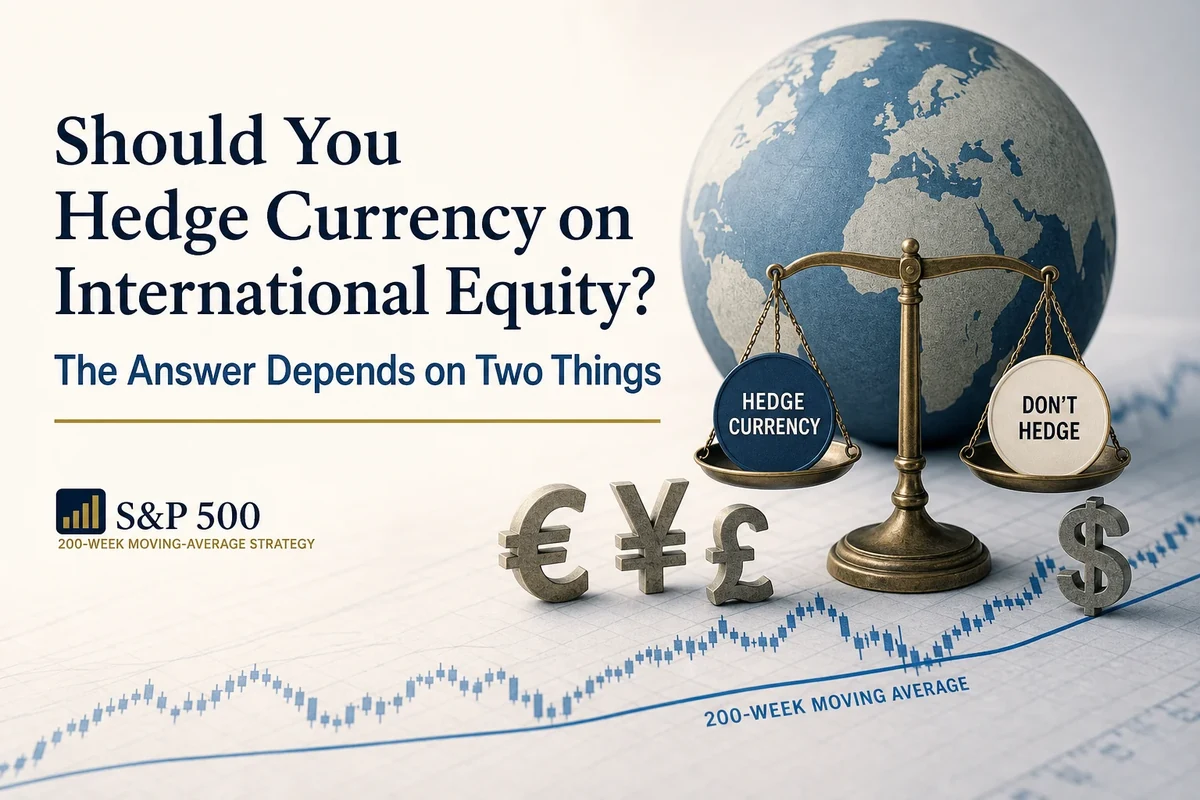
Currency hedging on international equity sounds like sensible risk management. You’re buying stocks denominated in euros, yen, and sterling, your expenses are in dollars, and the idea of watching a currency move undo a perfectly good year of equity gains is uncomfortable. The financial services industry is happy to sell you a hedged ETF that promises to remove that discomfort. For a large portion of investors, buying it is a mistake they will pay for quietly, in compounding cost, for decades.
The question of whether to hedge is not complex, but it is frequently answered badly because the intuition runs backwards. Currency exposure on international equity feels like a risk you should eliminate. In reality, it is a risk that often protects you, costs you nothing extra in the unhedged version, and tends to wash out over the time horizons that actually matter. The case for hedging is real, but it is narrower than the marketing materials suggest.
What Currency Hedging Actually Does Inside an ETF
When you buy an unhedged international equity ETF, you own two things simultaneously: the underlying stocks and the currencies those stocks are priced in. A position in a Japanese equity fund gives you exposure to the Tokyo Stock Exchange and to the yen. If the yen weakens against your home currency during your holding period, that currency move reduces your return. If the yen strengthens, it boosts your return. The equity and currency exposures are bundled together.
A currency-hedged ETF attempts to strip out the currency component by using forward contracts. The fund manager sells the foreign currencies forward, locking in today’s exchange rate for a future settlement date, typically one month out. At settlement, the hedge is rolled forward again. The mechanism works reasonably well at removing the bulk of currency fluctuations from your return, but it is not perfect. Because the hedge is reset monthly while the underlying stocks move daily, the hedge is perpetually slightly too large or slightly too small relative to the portfolio. That imprecision is generally modest over short periods but introduces tracking noise that adds up.
More importantly, the hedge has a direct cash cost. Forward contracts are priced by the interest rate differential between the two currencies involved. When the interest rate in your home country is lower than the rate in the currency you are hedging from, you pay a cost to hold that hedge. When the differential runs the other way, the hedge is cheap or even slightly positive. This asymmetry is not a theoretical concern. Consistent evidence shows that hedging costs for investors holding US equities from a lower-rate home currency have historically run between roughly 0.5% and 1.5% per year, depending on how wide the rate gap has been. That drag compounds. Over a 20-year accumulation period, even 0.75% per year in additional drag represents a meaningful reduction in terminal wealth.
Hedging costs scale with interest rate differentials. When the US federal funds rate sits significantly above most other developed-market rates, the cost of hedging a foreign portfolio back into dollars rises sharply. That cost is not a fee line on a fund factsheet, it is embedded in the returns gap between the hedged and unhedged versions of the same fund.
The First Thing That Determines Your Answer: Time Horizon
Over short holding periods, currency movements can swamp equity returns. A five-percent move in the dollar-euro rate in a single quarter is not unusual. For a portfolio worth ten years of retirement savings, a five-percent currency hit in year one matters enormously. This is the case for hedging, and it is a genuine one.
Over long holding periods, it largely dissolves. Exchange rates between developed economies tend to gravitate toward purchasing power parity over multi-decade spans. The theory is straightforward: if goods consistently cost more in one country than another at a given exchange rate, trade flows and capital flows eventually adjust that rate. The mechanism is messy and slow, and it breaks down completely over shorter horizons, which is precisely why currencies cause such anxiety. Over the 15-to-30-year investment horizons common to serious accumulation investors, however, evidence suggests that large exchange rate divergences tend to partially or fully correct.
This mean-reversion tendency means that currency exposure over long periods is closer to noise than to structural risk. You may have a bad currency decade followed by a good one. An unhedged investor who started accumulating in a period of domestic currency strength will likely see some of that headwind reverse later in the cycle. The hedged investor, by contrast, pays the forward contract cost every single month, in every market condition, with no chance of currency gains offsetting that cost on the upside.
The practical rule of thumb that follows from this is grounded in evidence rather than marketing: investors with a time horizon beyond roughly ten years are almost always better served by unhedged international equity. The hedging costs over that period will exceed the volatility-reduction benefit, particularly when you account for the long-run reversion of exchange rates. As the horizon shortens toward five years and below, the calculus starts to shift.
The Second Thing: Where You Will Spend Your Money
The second dimension is less discussed but equally important. Currency risk is only real risk to you if the currency mismatch affects your purchasing power at the time you need to spend. An investor who earns, saves, and will ultimately spend in US dollars faces genuine currency risk when holding foreign-denominated assets. If the yen falls forty percent over the period in which you are drawing down your portfolio, and a meaningful portion of your wealth was in unhedged Japanese equities, you retire with less purchasing power in your own currency than the underlying stock performance would suggest.
Now consider the same investor during the accumulation phase. Every year, new contributions in dollars go into the portfolio. Currency movements that cause the portfolio to dip one year create a lower purchase price for the next contribution, effectively building in a form of currency cost-averaging. The mismatch between investment currency and spending currency is a problem primarily at the point of liquidation, not during accumulation.
A retiree in the drawdown phase with most of their spending in their home currency and a meaningful allocation to international equity is the profile for whom hedging makes the clearest sense. The time horizon is short, the spending currency is fixed, and reducing short-term portfolio volatility has genuine practical value. It is worth paying a hedging cost to reduce the chance that an adverse currency move forces you to sell equity at a temporarily depressed value to fund living expenses.
Currency risk only converts into real financial harm when a mismatch between investment currency and spending currency coincides with a forced liquidation. During accumulation, that mismatch is largely theoretical. In retirement drawdown, it becomes material, and that is where hedged ETFs earn their place.
The Crisis Phenomenon: When Hedging Can Hurt Badly
One counterintuitive finding from the data deserves serious attention before any investor reaches for a hedged ETF as protection. During equity market crises, the major reserve currencies, particularly the US dollar, Japanese yen, and Swiss franc, tend to appreciate sharply against smaller developed-market and commodity-linked currencies. Many investors assume a hedged ETF is the safer choice in a downturn. The data from the COVID crash of February to March 2020 illustrates why that assumption deserves scrutiny.
During that episode, the US dollar appreciated against the Canadian dollar by around 9 to 10 percent, in line with its typical safe-haven behaviour during global risk-off periods. Canadian investors holding unhedged US equity ETFs lost roughly 28 to 29 percent in Canadian dollar terms over that stretch. Their counterparts holding currency-hedged US equity ETFs lost closer to 37 percent, because the hedge stripped away the currency cushion that the US dollar’s safe-haven appreciation would otherwise have provided. The hedge turned a bad outcome into a worse one.
The pattern holds across crisis episodes more broadly. When a domestic economy weakens, its currency tends to weaken with it, and a portfolio of unhedged foreign equities provides a natural offset to that domestic deterioration. The currency exposure you paid nothing for becomes a form of portfolio insurance precisely when you need it most. Hedging neutralizes that insurance. For investors in small open economies whose currencies tend to fall during global downturns, this dynamic is not a minor consideration, it can materially affect the real-world outcome during the periods that matter most.
The Clear Exception: Fixed Income Is Different
Everything said above about equity applies specifically to equity. The case for currency hedging in fixed income is close to the reverse. Bonds serve a different role in a portfolio: they are there to reduce volatility, provide liquidity during drawdowns, and offer a counterweight to equity risk. When you hold foreign bonds unhedged, you introduce currency volatility that can overwhelm the modest yield the bonds provide. An unhedged foreign government bond can behave more like a currency trade than a fixed income position, which defeats the purpose entirely.
For this reason, the consensus among most serious portfolio builders is to hedge currency exposure on any significant fixed income allocation held internationally, and to do so regardless of time horizon. The stabilising role of bonds requires that their volatility come from interest rate movements and credit quality, not from exchange rate swings. This is one area where the hedge is worth its cost almost universally, because the cost of currency noise in fixed income is higher than the hedging fee.
The practical implication: an investor building a global multi-asset portfolio can sensibly run unhedged international equities alongside currency-hedged international bonds. These are not contradictory positions. They reflect different jobs being done by different asset classes.
How This Maps to Real Portfolio Decisions
Translating the framework into practice involves matching the two criteria honestly. A 35-year-old saving for retirement in 30 years, spending primarily in their home currency, and allocating 20 to 30 percent of their equity portfolio internationally has no strong case for currency hedging on those equity positions. The time horizon is long enough that exchange rate mean-reversion is likely to do most of the work, the hedging cost will compound against them for three decades, and crisis episodes will tend to benefit them through the currency cushion on unhedged foreign positions. Their fixed income, if held internationally at all, should be hedged.
A 62-year-old planning to begin drawdown in three years, with most living expenses denominated in their home currency, should think differently. The time horizon is short enough that a significant currency move during the early drawdown years could materially affect retirement security. Gradually shifting international equity exposure toward hedged versions as the drawdown date approaches is a reasonable transition, mirroring the general principle of reducing portfolio volatility as the investment horizon compresses. The tolerance for short-term volatility declines when you can no longer afford to wait for a recovery.
For investors considering their international allocation more broadly, it is worth noting that the right question about currency hedging is inseparable from the question of how much international equity exposure makes sense in the first place. A 5 percent allocation to international stocks creates minimal currency risk regardless of whether it is hedged or not. A 40 percent international allocation creates meaningful currency exposure that warrants a deliberate decision. The currency hedging question only becomes urgent when the allocation is large enough to move your portfolio. Understanding how long-cycle thinking shapes every portfolio construction decision is central to the Buy the 200 strategy, which treats time horizon as the foundational variable in building a durable portfolio.
The Cost Argument Is Decisive for Most Investors
The weight of evidence tips toward unhedged for the majority of global equity investors, and the cost structure is the primary reason. Currency-hedged ETFs are not dramatically more expensive in terms of stated management fees. In some cases the fee difference is negligible. But the embedded cost of running the forward contract programme is real, variable, and not always prominently disclosed. It scales with interest rate differentials and eats directly into the return that the hedge is supposed to protect.
When rates are similar across developed markets, hedging costs are low and the argument is closer to a wash. When rate differentials widen, as they did substantially in the post-2022 hiking cycle when the US Federal Reserve moved rates significantly above many developed-market peers, hedging costs for non-US investors holding US equities rose sharply. That is precisely the period when hedging looks most attractive on paper because the dollar is strong, but it is also precisely the period when the hedge is most expensive to maintain. The two effects offset each other in a way that leaves unhedged investors roughly whole while hedged investors absorb the forward contract cost.
The moments when hedging looks most appealing on paper tend to be the moments when it costs the most. A strong foreign currency creates anxiety and tempts investors toward hedged products. But that same currency strength has already boosted the unhedged portfolio’s returns, and the hedge now comes with a forward contract cost that reflects the high rate environment driving that currency’s strength. You are often paying most to hedge at exactly the wrong time.
Long-term investors who think in decades rather than quarters, which is the orientation that sensibly drives a passive index approach, will find that the compounding mathematics of hedging costs tends to outweigh the smoothing benefit over most realistic holding periods. The discipline of staying invested through currency volatility is admittedly harder than smoothing it away, but it is the approach that typically produces better terminal wealth. Understanding this framework is also relevant to any investor thinking carefully about the long-cycle patience that separates successful wealth compounders from those who optimise short-term comfort at long-term cost.
Frequently Asked Questions
Q: Does it ever make sense to hedge international equity during accumulation?
A: Occasionally. If you are within three to five years of a major planned expenditure in your home currency, or if you are carrying a very large international allocation relative to your overall portfolio and approaching retirement, there is a reasonable argument for partial or full hedging. For most accumulation investors with a horizon exceeding ten years, the hedging cost exceeds the benefit and unhedged positions are the more efficient choice.
Q: Are currency-hedged ETFs more expensive than unhedged versions?
A: In stated management fees, often only marginally so. The real cost difference lies in the forward contract programme embedded in the hedged fund’s structure. This cost varies with the interest rate differential between currencies and is not always transparent in the fund’s expense ratio. When interest rate differentials are wide, the embedded hedging cost can run materially above the stated fee difference between the two fund versions.
Q: Should I hedge my international bond exposure even if I don’t hedge my equity?
A: Yes. Bonds and equities play different roles in a portfolio. Bonds are held primarily to reduce portfolio volatility, and unhedged foreign bonds can introduce currency swings that overwhelm the modest yield they provide. The case for hedging fixed income internationally is strong regardless of time horizon, because the purpose of the bond allocation is undermined if currency volatility is layered on top of it.
Q: How much does my domestic currency’s behaviour matter to this decision?
A: It matters considerably. Investors in commodity-linked or smaller open-economy currencies tend to benefit most from unhedged international equity because their home currency typically falls during global crises, at exactly the moment when the unhedged portfolio’s foreign currency exposure provides a natural cushion. Investors in major reserve currencies face a different dynamic: the currency often strengthens in risk-off periods, which means unhedged foreign equity still provides geographic diversification, but without the crisis-cushion effect working as strongly in their favour.