№ 019 · Education · · 12 min
Buybacks vs. Dividends: The Argument Both Sides Get Wrong
The debate between share buybacks and dividends has produced more heat than light for decades. The real question isn't which tool is superior — it's whether management is using either one with the discipline the situation actually demands.

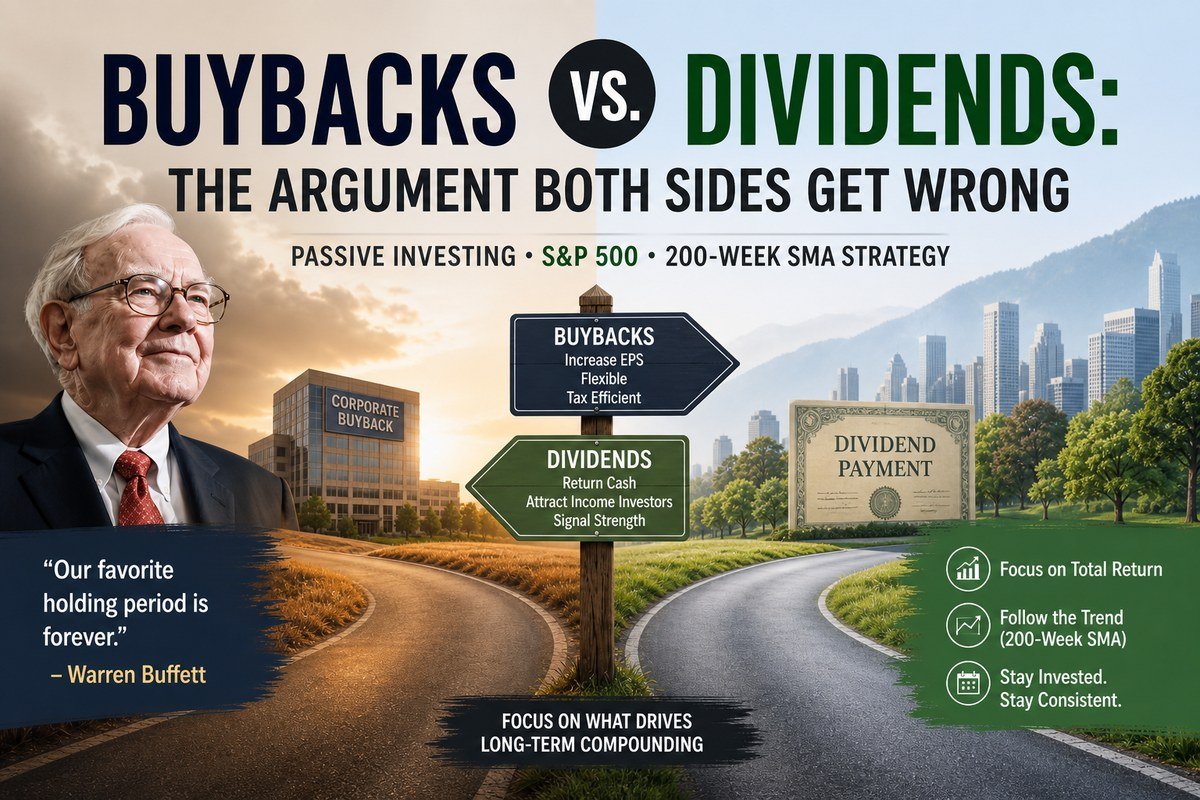
The internet has a well-worn groove when it comes to buybacks versus dividends. Dividend investors argue that buybacks are financial engineering designed to flatter earnings per share and enrich executives whose compensation is tied to the stock price. Buyback advocates counter that dividends are an inefficient, tax-forced distribution that removes the investor’s choice of when to realise a return. Both camps produce spreadsheets, academic citations, and passionate conclusions. Both camps are also, in important ways, arguing past the actual problem.
The real issue is not which mechanism is inherently superior. The real issue is whether management is deploying either tool with genuine capital allocation discipline, or whether they are reaching for whichever option produces the most flattering optics at the moment. Getting that distinction right matters far more for long-term investors than winning the theoretical debate.
The Modigliani-Miller Starting Point
Any serious discussion starts with the same foundation. In a world without taxes, transaction costs, or informational asymmetries, it genuinely does not matter whether a company returns a dollar to shareholders as a dividend or as a buyback. The shareholder ends up with the same economic claim. If a company pays a $1 dividend, the stock price drops by roughly $1 on the ex-dividend date, and the shareholder holds the same wealth in two forms: cash and a slightly smaller share position. If the company instead spends that dollar repurchasing shares, the remaining shares each represent a fractionally larger claim on the same enterprise. The investor who wants liquidity can sell a small slice of their position and achieve the identical outcome.
This theoretical equivalence is the correct baseline. Most of the popular debate ignores it and proceeds directly to real-world distortions. Those distortions are real and important. But starting from theoretical equivalence keeps the analysis honest: it forces us to ask why the choice matters rather than simply asserting it does.
Where Tax Treatment Actually Bites
In practice, taxes create a meaningful asymmetry, and it runs in the direction buyback advocates claim. In most major jurisdictions, dividends are taxable in the year they are paid, regardless of whether the investor needs or wants the income. A long-term investor compounding wealth in a taxable account receives a dividend, pays tax immediately, and reinvests what remains. The compounding base is smaller from that point forward, and it stays smaller. Capital gains from a buyback-driven share price increase, by contrast, are only taxable when the investor chooses to sell. The investor retains full control over timing, and can defer the taxable event for years or decades. Over long compounding periods, this deferral advantage is meaningful.
The tax argument is real but context-dependent. Investors holding shares in tax-deferred retirement accounts face no current-year tax on dividends, which equalises the playing field considerably. Large institutional holders, pension funds, sovereign wealth funds, endowments, often have no direct tax liability at all. The tax efficiency of buybacks primarily benefits investors in taxable accounts with long holding periods. It is an important consideration, not a universal trump card.
The dividend tax drag is real for long-term investors in taxable accounts. But it only matters if the buyback alternative is executed with genuine price discipline. A tax-efficient way to overpay for your own shares still destroys value.
The Signaling Problem That Neither Side Fully Acknowledges
Dividends carry a commitment that buybacks do not. When a company initiates or raises a dividend, it is making an implicit pledge to sustain that payment. Management teams know that cutting a dividend sends a severe negative signal to the market, one that typically results in immediate share price punishment. This asymmetry creates a powerful discipline. Companies that raise dividends consistently over extended periods, a category that is far smaller than the popular conception suggests, with research indicating fewer than 300 companies have managed even a single decade of consecutive increases at any given time, have effectively screened themselves for financial stability, earnings quality, and conservative capital management.
Buyback authorisations carry no equivalent commitment. A company can announce a $10 billion repurchase programme and then execute very little of it, particularly if conditions change or management priorities shift. Research on buyback completion rates has repeatedly found that a substantial fraction of authorised programmes are never fully executed. The announcement itself generates positive market sentiment, which creates an incentive to announce frequently regardless of intent. This is not a minor quibble: if the signal is unreliable, the information content is limited.
Dividends also shape the investor base in ways that matter for long-term holders. Peter Lynch observed that regular dividends give shareholders a tangible reason to stay during difficult periods. Companies with long track records of dividend growth tend to attract what researchers have termed quality shareholders: patient, long-horizon investors who care about business fundamentals rather than quarterly price momentum. That shareholder composition has real effects on how management is evaluated and what time horizons they are implicitly held to.
The Valuation Sensitivity of Buybacks
This is the central flaw in the buyback-is-always-better argument, and it does not receive nearly enough emphasis. A dividend pays shareholders the same value regardless of whether the stock is cheap or expensive. It is mechanically indifferent to valuation. A buyback is not. When a company spends $1 billion repurchasing shares, the return to remaining shareholders depends entirely on the price paid relative to the business’s intrinsic value.
If shares are trading at a meaningful discount to intrinsic value, buybacks are extraordinary value creation for remaining shareholders. Warren Buffett has stated clearly that Berkshire Hathaway will repurchase its own shares when they trade at a meaningful discount to conservative estimates of per-share intrinsic value. This is capital allocation applied properly: treating the company’s own shares as an investment that must clear the same hurdle rate as any other use of capital. Berkshire currently generates over $61 billion in annual free cash flow, which gives management genuine optionality about when and how to deploy this lever. When shares have traded near or above intrinsic value, Buffett has historically preferred to accumulate cash rather than repurchase at unfavourable prices.
Most corporate managements do not exercise this discipline. The pattern that research has documented is a consistent and troubling one: buyback volumes across the broad market tend to be highest when markets are near peaks and lowest during corrections. Companies collectively buy the most of their own stock when it is most expensive, and pull back when prices fall. This is the opposite of sound capital allocation. It is also, not coincidentally, consistent with the incentive structure of executive compensation tied to short-term earnings per share. A buyback at any price reduces share count and mechanically inflates EPS. If executive bonuses are tied to EPS rather than per-share intrinsic value growth, the incentive to repurchase regardless of price is structural.
The textbook case for buybacks assumes management has both the information and the discipline to repurchase only when shares trade below intrinsic value. The real-world case for dividends rests partly on the observation that this assumption often does not hold.
When Each Tool Is the Right One
With that framework in place, the conditions under which each mechanism makes sense become clearer. Buybacks are the superior tool when three conditions are met simultaneously: the company’s shares trade at a genuine discount to conservatively estimated intrinsic value, the company has no better use for the capital that would return more than the implied yield on its own undervalued stock, and management has the conviction and credibility to resist the temptation to repurchase opportunistically at peaks. Apple’s buyback programme is often cited in this debate, and for good reason. Apple generates over $101 billion in annual free cash flow, carries extremely high returns on assets, and has used buybacks to reduce its share count substantially over many years. The aggregate effect has been meaningfully positive for long-term shareholders at various points in that programme. But Apple is not typical. Its free cash flow generation is extraordinary, and the management team has consistently demonstrated operational discipline that many companies cannot credibly claim.
Dividends are the superior tool, or at least the more honest tool, when management cannot be confident that shares are cheap, when the investor base includes a meaningful number of income-dependent shareholders who need current cash flows, or when the business is mature enough that retained earnings are unlikely to generate returns above the cost of capital. A mature utility, a well-established consumer staples business, or a financial company in a capital-intensive industry may find that regular dividends are both the clearest signal of financial health and the most appropriate use of surplus cash. Our research of quality-shareholder research is direct on this point: companies with significant executive stock option compensation coupled with significant share buybacks often represent situations where dividends would serve long-term holders better, because the incentive to repurchase is detached from the valuation discipline that makes buybacks rational.
The worst outcome, and a more common one than either camp acknowledges, is management using buybacks as a substitute for genuine strategic thinking, deploying capital at elevated valuations while framing it as prudent shareholder return. A Harvard Business Review analysis published in early 2026 noted that boards often misunderstand the true cost of buybacks, treating them as relatively costless when opportunity cost and valuation timing errors can be substantial over a full cycle.
The Shareholder Yield Frame
For investors evaluating companies from the outside, the most useful lens is shareholder yield: the combination of dividend yield and net buyback yield (buybacks minus share issuances) expressed as a percentage of market capitalisation. This metric makes explicit what is otherwise obscured by looking at either mechanism in isolation.
A company with a 1.5% dividend yield and a 3% net buyback yield is returning roughly 4.5% of its market value to shareholders annually. A company with a 4% dividend yield that is simultaneously issuing shares to fund executive compensation plans at 1.5% per year is actually returning only 2.5% on a net basis. The gross dividend number looks superior, the economic reality is the opposite. Share issuance through stock-based compensation is a real cost to existing shareholders, and any honest accounting of capital return must net it out.
High shareholder yield, when accompanied by strong business fundamentals and reasonable valuation, has historically been associated with above-average long-term returns. The mechanism is straightforward: a business that generates more cash than it needs to maintain and grow operations, and returns that surplus to shareholders in a consistent and disciplined manner, is expressing both financial health and management alignment with long-term owners. The form of the return matters less than the quality and sustainability of the underlying cash generation that makes it possible.
Shareholder yield, dividends plus net buybacks as a share of market cap, is a more complete measure of capital discipline than either metric alone. Always net out share issuance before drawing conclusions.
What Long-Term Investors Should Actually Look For
The practical implication for serious investors is to shift the question entirely. Rather than asking whether a company pays dividends or does buybacks, ask whether the capital allocation decisions, whatever form they take, are being made with reference to a clear and conservative estimate of intrinsic value. Ask whether share count is actually declining on a net basis over time, or whether buybacks are merely offsetting stock-based compensation dilution. Ask whether dividend growth has been sustained through a full business cycle, including the periods when sustaining it required genuine financial resilience. Ask whether free cash flow is the source of the distributions, or whether the company is funding shareholder returns with debt.
Management teams who can articulate a clear capital allocation hierarchy, reinvest at returns above cost of capital first, maintain a conservative balance sheet second, return surplus capital in whichever form best serves the long-term investor base third, are the ones worth trusting with either tool. Those who fall back on the language of “returning value to shareholders” without demonstrating price discipline or genuine analytical rigour are often doing something else entirely.
The debate between buybacks and dividends, in its popular form, is a proxy for a more fundamental question about management quality and capital discipline. It is possible to be aggressively wrong on both sides: to pay dividends that are only sustained by taking on debt, or to execute buybacks at valuations that destroy rather than create per-share value. The investors who focus on the quality of the underlying cash generation, the discipline of the deployment, and the net economic effect on per-share intrinsic value over time will consistently make better decisions than those arguing about which mechanism has the better theoretical pedigree.
Frequently Asked Questions
Q: Are buybacks always better than dividends from a tax perspective?
A: For investors in taxable accounts with long holding periods, buybacks can be more tax-efficient because capital gains are deferred until sale, while dividends are taxed in the year received. However, this advantage disappears in tax-deferred accounts, and it is irrelevant if the buyback is executed at an inflated valuation, which eliminates the underlying economic benefit regardless of tax treatment.
Q: Does a company raising its dividend signal confidence in the business?
A: Historically, yes. Dividend initiations and increases carry meaningful positive signals because management is making an implicit commitment they know is costly to reverse. Companies with sustained records of consecutive dividend growth have effectively demonstrated earnings durability and disciplined balance sheet management through multiple economic cycles. That signal is more reliable than a buyback announcement, which carries no equivalent commitment to execute.
Q: What is shareholder yield, and why does it matter more than dividend yield alone?
A: Shareholder yield adds the net buyback yield (buybacks minus new share issuances) to the dividend yield, expressing total capital returned to shareholders as a percentage of market cap. It matters because many companies run large buyback programmes while simultaneously issuing shares for executive compensation, which partially or fully offsets the repurchases. Looking at dividend yield alone misses the dilution, looking at gross buybacks alone ignores it as well. The net figure is the honest one.
Q: When is it genuinely rational for a company to prefer buybacks over dividends?
A: The rational case for buybacks over dividends is strongest when three things are true: shares trade at a clear discount to intrinsic value, the company has no internal investment opportunities returning above the cost of capital, and management has the discipline to reduce or halt repurchases if valuation rises materially. When all three conditions hold, buybacks create more per-share value than an equivalent dividend. In practice, the valuation discipline condition is the one most frequently absent, which is why the theoretical case for buybacks is often stronger than the empirical record of most corporate repurchase programmes.