№ 026 · Deep Dive · · 12 min
Berkshire Without Buffett: What the Operating Engine Actually Looks Like
Buffett is gone from the CEO seat. What remains is an insurance float machine, two capital-intensive giants, and dozens of durable subsidiaries. Here's what Greg Abel actually inherited.

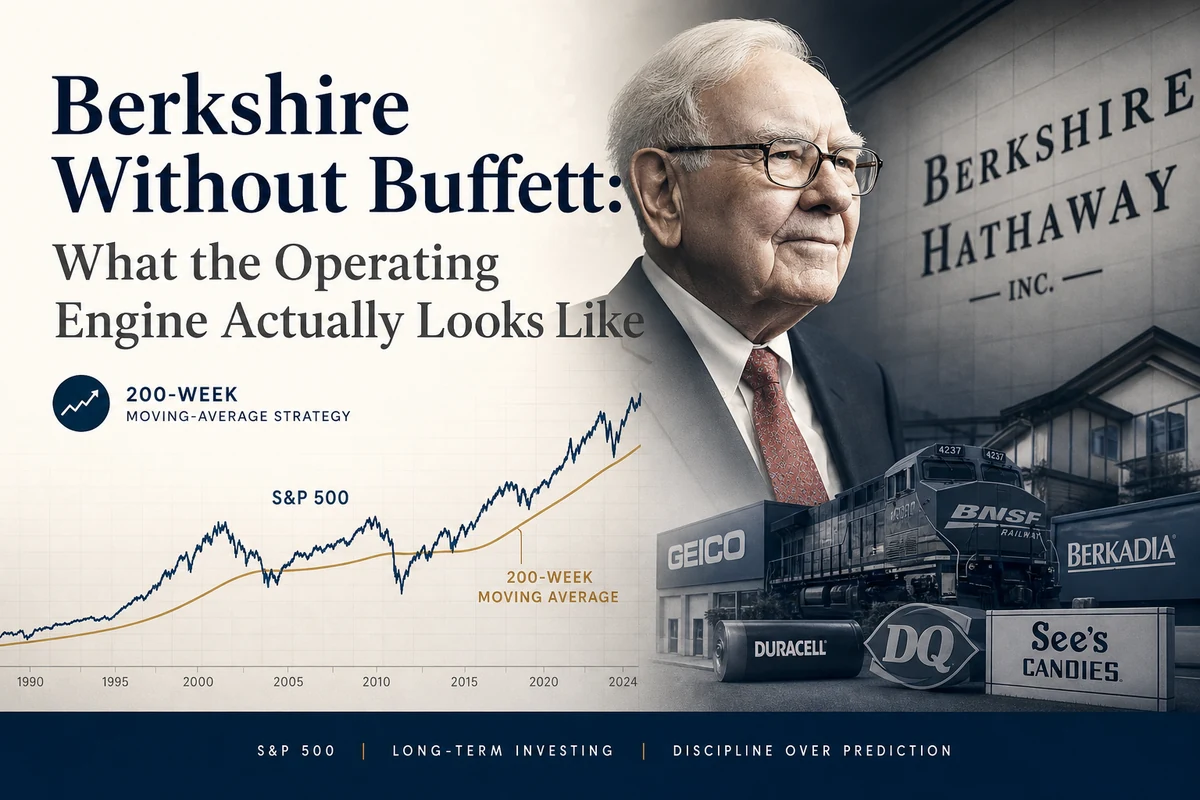
Warren Buffett stepped down as CEO of Berkshire Hathaway at the end of 2025, ending a six-decade run that is unlikely to be repeated in any of our lifetimes. Greg Abel, who has run Berkshire Hathaway Energy since 2008 and has served as vice chairman of non-insurance operations since 2018, assumed the CEO role. The market reaction was predictable: questions about whether Berkshire without Buffett is still Berkshire, whether the cult of personality was the product, and whether the whole thing begins to erode. These are reasonable questions. They are also largely the wrong ones. The more useful question is what the operating machine actually looks like from the inside, because most of what made Berkshire exceptional over the last 30 years was structural long before this transition arrived.
What Berkshire Actually Is
The popular narrative treats Berkshire as a stock portfolio with a legendary curator attached. The reality is nearly the reverse. The equity portfolio, impressive as it is, sits on top of an operating conglomerate that generates tens of billions of dollars in annual earnings from businesses Berkshire owns outright. Understanding the transition requires understanding that operating layer first.
Berkshire today has three distinct economic engines. The first is insurance, anchored by GEICO, General Re, Berkshire Hathaway Reinsurance Group, and a collection of smaller specialty insurers. The second is a pair of regulated, capital-intensive giants: BNSF, the railroad, and Berkshire Hathaway Energy, the utility. The third is a sprawling collection of manufacturing, retail, and service businesses that includes names like Clayton Homes, Precision Castparts, Lubrizol, Marmon, Forest River, and dozens more. Each of these layers has its own economic logic, and none of it requires a particular person’s presence to function.
Berkshire’s approach, as Buffett explained in the 2014 annual letter, was deploying capital into “controlled businesses that achieve good-to-excellent returns on the net tangible assets each requires.” The float engine then funds further acquisition without diluting existing shareholders. That flywheel predates Buffett’s departure by decades and will outlast the transition.
The Float Machine: Berkshire’s Most Misunderstood Asset
Insurance float is the most important structural advantage Berkshire possesses, and it is almost certainly the least understood by retail investors who track the stock. Float is the pool of money insurers hold between collecting premiums and paying claims. It is not Berkshire’s money in a strict accounting sense, but Berkshire can invest it for its own benefit for as long as the insurance operation remains a going concern.
In 1970, Berkshire’s float stood at $39 million. By 2000, it had reached $28 billion. By 2014, it was $84 billion. Current estimates from Berkshire’s filings suggest it now exceeds $160 billion. That growth happened not through financial engineering but through disciplined underwriting. Berkshire has maintained underwriting profitability in the vast majority of years across its insurance history, meaning the float has often been genuinely cost-free or better. Where the rest of the property-casualty industry pays for its float through underwriting losses, Berkshire has been paid to hold its.
What does this mean in practice? A pool of investable capital above $160 billion, funded at a cost that in many years rounds to zero, sitting alongside Berkshire’s own equity. The investment income that float generates does not show up in the operating earnings of the insurance segment itself, but it powers the entire enterprise. This is not a personal trait of Warren Buffett. It is a balance sheet characteristic. Greg Abel inherits it fully intact.
BNSF and BHE: The Regulated Giants
The two largest non-insurance subsidiaries tell a consistent story about the kind of businesses Berkshire prefers to own. BNSF, acquired in 2010 for roughly $44 billion, is America’s largest freight railroad measured by freight volume. Berkshire Hathaway Energy, of which Berkshire owns approximately 92%, is a diversified utility with operations across multiple U.S. states, the United Kingdom, and Canada. Together, the two have historically contributed around one-third of Berkshire’s after-tax operating earnings.
Their shared characteristics are worth spelling out. Both operate under regulatory frameworks, which cap returns on one end but also protect competitive position on the other. Both carry long-lived, hard-to-replicate physical assets: rail networks, transmission lines, pipelines, generating capacity. Both carry their own long-term debt, none of it guaranteed by the Berkshire parent, yet both have maintained interest coverage that Buffett himself described as “far exceeding” requirements even in weak economic conditions. BNSF’s interest coverage in a weak railroad year still ran above 8-to-1, as confirmed in multiple annual letters.
Greg Abel ran Berkshire Hathaway Energy for over 15 years before becoming vice chairman, and Buffett praised his and Dave Sokol’s results there as early as the 2008 annual letter, calling them “unmatched elsewhere in the utility industry.” Abel is not a CEO who is unfamiliar with large capital expenditure decisions, regulatory relationships, or long-duration asset management. His background is precisely the kind of operational depth that the BHE and BNSF businesses require in the decades ahead, as both face substantial capital spending on energy transition infrastructure and network modernization.
The Manufacturing and Services Layer
Below the two regulated giants sits a collection of businesses that Buffett described in the 2017 annual letter as delivering more than $20 billion in pre-tax income from non-insurance operations. The hierarchy runs from large to small: Clayton Homes in manufactured housing, Lubrizol in specialty chemicals, Precision Castparts in aerospace components, Marmon in industrial manufacturing, and then dozens of smaller businesses across industries ranging from furniture retail to private aviation to candy.
The aggregate economics of this layer have been genuinely impressive across multiple annual letter reporting periods. Buffett noted in the 2014 letter that these businesses earned 18.7% after-tax on net tangible assets despite holding large quantities of excess cash and using little leverage. Returns of that order on tangible capital, sustained across a diversified collection of industries, are not an accident of brilliant stock selection. They reflect the quality filter that Berkshire applied at the time of each acquisition and the discipline of not overpaying for businesses that do not earn well on capital.
Critically, these businesses are managed autonomously. Berkshire’s headquarters in Omaha has historically employed fewer than 30 people for a conglomerate with several hundred thousand employees globally. Subsidiary CEOs do not report to quarterly earnings calls at headquarters. They do not navigate corporate approval chains for routine capital decisions. They run their own operations, and Berkshire’s role is to allocate the surplus cash those operations generate. That decentralized structure is embedded in how Berkshire operates, not in the personality of a single leader. New CEOs inherit the culture, not just the org chart.
“Our trust is in people rather than process. A ‘hire well, manage little’ code suits both them and me.” That principle, from Buffett’s 2010 annual letter, describes an institutional design that was already decades old when it was written. It does not require Buffett to perpetuate it.
What Greg Abel’s Capital Allocation Challenge Actually Looks Like
The genuine uncertainty in the post-transition era is not whether GEICO will keep writing policies or whether BNSF trains will keep running. It is whether Berkshire can continue to deploy the capital those businesses generate at attractive rates of return. This is the capital allocation problem that all mature conglomerates face, and it is the place where Buffett’s personal judgment historically added the most compounding leverage.
The scale of the challenge is real. Berkshire’s free cash flow came in above $61 billion in the most recently reported period. The existing cash and short-duration Treasury reserve, built partly from Buffett’s long-standing caution about overpriced acquisitions, is substantial by any measure. Finding acquisition targets that are large enough to move the needle, priced fairly, and culturally compatible with Berkshire’s permanent ownership model is genuinely hard at this scale.
Abel has already signaled, through his first shareholder letter as CEO and through early public statements, that he intends to maintain the acquisition discipline Berkshire is known for rather than chasing scale for its own sake. He also purchased approximately $15 million of BRK-B shares in open-market transactions in early 2026, a gesture that communicates alignment with shareholders in the clearest possible way. Whether his acquisition judgment over the next decade matches Buffett’s over the last one is unknowable in advance. The structural advantages available to whoever sits in that chair, however, are unchanged.
The Valuation Question Investors Are Actually Asking
BRK-B currently trades at a trailing price-to-earnings ratio of 14.32x, with free cash flow of $61.2 billion and a market capitalization just above $1 trillion. The forward P/E is higher, at 22.57x, reflecting the gap between reported earnings and the more volatile mark-to-market accounting treatment Berkshire is required to apply to its equity portfolio under current GAAP rules. Buffett himself spent years urging shareholders to focus on operating earnings rather than GAAP net income precisely because unrealized portfolio gains and losses distort the picture quarter to quarter.
The operating engine valuation, separated from portfolio noise, is reasonable for a business of this quality. A free cash flow figure above $61 billion, generated by businesses with genuine moats, supported by a cost-free float pool exceeding $160 billion, and held within a structure that requires no external financing, would command a premium multiple from most institutional buyers if it were disaggregated and sold separately. The broader market context matters here too. With the Shiller CAPE ratio at 41.35x, well above its long-run historical average of around 16-17x, and the Buffett indicator showing total U.S. market capitalization at roughly 139% of GDP, Berkshire’s more modest valuation relative to the broader market index reflects some transition discount but also the relative conservatism of its underlying earnings base.
For long-term investors thinking about whether to own Berkshire as part of a portfolio that includes broad S&P 500 index exposure, the question is not primarily about succession risk. It is about whether the business economics justify the price. At current levels, with the transition uncertainty already reflected in a stock that has underperformed the index modestly in recent quarters, the setup is not obviously unfavorable, though outcomes for any individual holding depend heavily on the valuation at the time of purchase. Those considering how individual equity positions like Berkshire complement a passive index core may find the Buy the 200 strategy guide a useful framework for thinking about when individual positions add genuine diversification versus overlap.
Berkshire’s intrinsic value does not live in Warren Buffett’s head. It lives in the float, the railroad, the utility, the insurance subsidiaries, and the culture of decentralized ownership. Those things transferred intact on January 1, 2026.
Structural Advantages That Outlast Any CEO
The most durable competitive advantages in Berkshire’s history were never personality-dependent. The insurance float mechanism has been building for nearly 60 years. The permanent-ownership acquisition model, which allows sellers to avoid the disruption of private equity processes and the loss of operational independence, is a structural offer that no competitor has successfully replicated at scale. The decentralized management philosophy, which keeps talented subsidiary operators in place by giving them autonomy rather than subjecting them to headquarters bureaucracy, creates retention that money alone cannot buy.
Buffett noted in the 2014 annual letter that the company was “ideally positioned for life after Charlie and I leave the scene” because the culture was “embedded throughout their ranks” and “regenerative.” Business owners and operators with compatible values would continue to be attracted to Berkshire as a permanent home. That remains true. The pipeline of acquisition candidates who prefer the Berkshire model to a sale to financial buyers has not evaporated because the name on the CEO door changed.
What long-term holders of BRK-B are really underwriting is not Greg Abel’s personal judgment over the next 20 years, though that judgment matters at the margin. They are underwriting the proposition that a company built on durable economics, a unique liability-funded investment pool, and a culture of operational autonomy will continue to compound capital at a rate that competes respectably with a broad index fund. The historical evidence for that proposition, across Berkshire’s own annual letters and across decades of documented subsidiary performance, is considerably stronger than the succession anxiety in the financial press suggests.
For investors interested in the longer-term data on how large-cap compounders like Berkshire have fared relative to the S&P 500 across full market cycles, the S&P 500 200-week SMA history provides useful context on the index benchmarks against which any active holding should ultimately be measured.
Frequently Asked Questions
Q: Does Berkshire Hathaway lose its edge without Warren Buffett as CEO?
A: The structural advantages, including the insurance float, the permanent-ownership acquisition model, and the decentralized management culture, are built into how Berkshire operates rather than residing in any individual. Buffett’s personal judgment added compounding leverage, particularly in capital allocation, but the underlying businesses and their economics transfer fully to Greg Abel’s tenure. The transition introduces uncertainty at the margins, not at the foundation.
Q: What does Greg Abel actually bring to the CEO role?
A: Abel spent more than 15 years running Berkshire Hathaway Energy, one of the two largest operating subsidiaries, before becoming vice chairman of non-insurance operations in 2018. His background is directly relevant to the capital-intensive, regulated businesses that generate a significant share of Berkshire’s earnings. He is not a portfolio manager stepping into an operating role, he is an operator who has managed large-scale capital allocation decisions across long investment horizons throughout his career.
Q: Is Berkshire’s large cash position a problem or an advantage?
A: In the near term, holding a substantial cash reserve at elevated short-term interest rates generates meaningful income while preserving optionality for acquisitions. The longer-term challenge is that deploying capital at the scale Berkshire now requires is genuinely difficult when acquisition prices are elevated across most industries. Abel has indicated he will maintain the discipline of not overpaying rather than deploy capital for its own sake, which is consistent with how Buffett built the enterprise. The risk is prolonged opportunity scarcity, not reckless deployment.
Q: How does BRK-B compare to simply owning an S&P 500 index fund?
A: Berkshire offers different risk characteristics, not obviously superior ones. Its operating earnings base is diversified across economic sectors, and the insurance float gives it access to investable capital at costs unavailable to most investors. Over extended periods, low-cost index funds have proven exceptionally hard to beat on a risk-adjusted after-tax basis, as Buffett himself has consistently acknowledged. Holding BRK-B alongside a passive index core reflects a different bet than replacing the index with it entirely, and outcomes depend heavily on the valuation at the time of purchase.